CMA stands for Community Management Application. It is a self-service framework that structures and automates partner onboarding, data collection, and master data maintenance.
What Is the SEEBURGER Community Management Application?
Structure partner onboarding and data collection as secure self-service workflows – automated, transparent, and fully integrated into SEEBURGER BIS.
Executive summary: Community Management Application
The SEEBURGER Community Management Application (CMA) is a self-service framework that structures, automates, and securely manages interactions related to partner onboarding, master data maintenance, and data collection. CMA connects external partners, internal business units, and the technical integration landscape through a central application that is tightly embedded in the SEEBURGER Business Integration Suite (BIS).
The focus is on transforming data flows and organizational processes into standardized, reusable, and transparent self-service workflows.
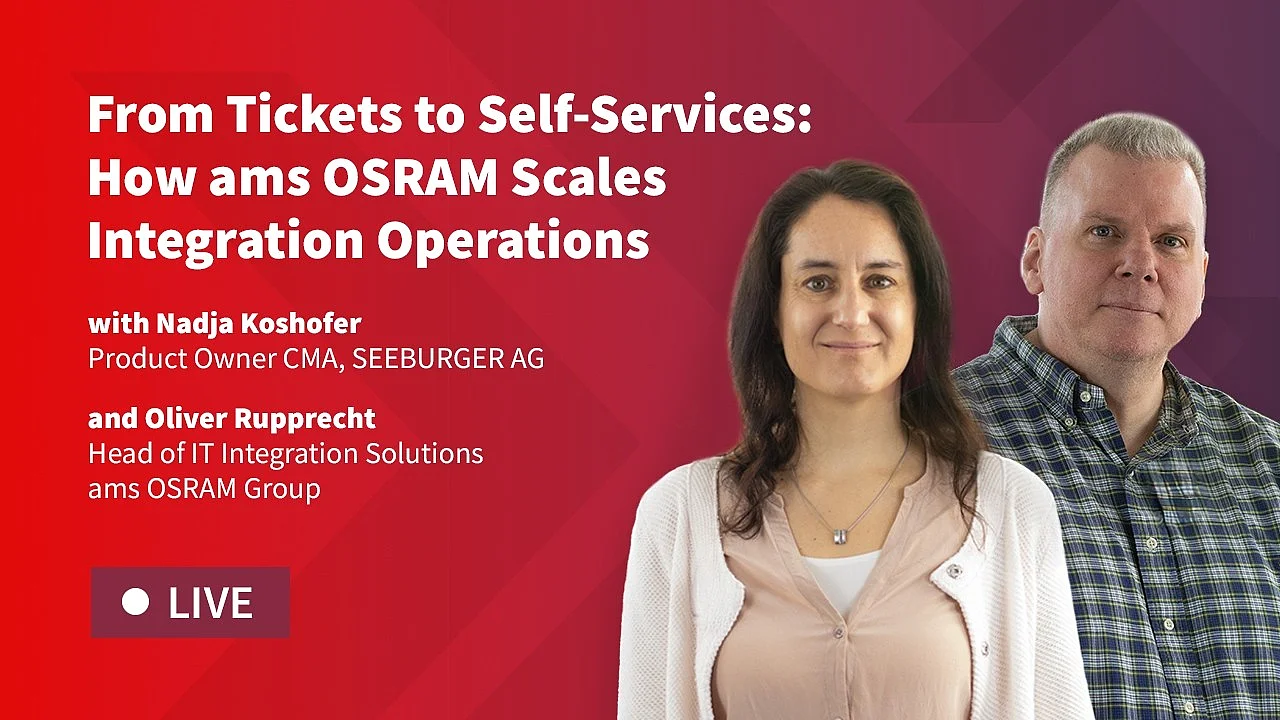
See CMA in Action at ams OSRAM
Discover how ams OSRAM uses SEEBURGER CMA to turn recurring integration tasks into structured self-services — improving transparency, reducing manual effort and helping IT teams scale daily operations more efficiently.
Why companies need a framework like CMA
 | Legacy processes slow down growth Many companies still rely on email loops, Excel templates, PDF forms, or individually developed tools. These approaches are error-prone, time-consuming, and difficult to track, especially when multiple teams and external partners are involved. |
 | Point solutions do not scale Standalone tools usually cover only individual process steps. End-to-end governance, reusability, and seamless integration with the integration platform are missing. |
 | Partner and data processes are becoming more complex Integrations require an increasing amount of information to be captured and kept up to date, such as formats, endpoints, contacts, or certificates. Manual maintenance is neither efficient nor reliable in the long term. |
 | Process quality and compliance are gaining importance Traceability, validations, clear role models, and auditability are key requirements of modern integration processes. They form the basis for controlling growing integration volumes in a structured way and meeting regulatory requirements on a sustained basis. |
Why CMA convinces in combination with the SEEBURGER BIS Platform
Consistent data foundation
End-to-end automation
Unified governance
Shared technological foundation
Flexible deployment models
How CMA works: core components

Open interfaces and standards
CMA supports established interface standards such as HTTP- and SOAP-based services as well as modern OpenAPI definitions. This enables flexible and controlled implementation of cross-system communication, validations, and automated workflows.

Self-service builder
Low-code capabilities allow forms, process steps, and guided onboardings to be modeled, for example for structured data collection or recurring workflows.

Survey engine
The survey engine supports structured data collection, ranging from contact details and technical parameters to format-specific information.

Organization and visibility management
Organizations and organizational units within user management clearly separate responsibilities, access rights, and data visibility, both for internal teams and external partners.
Governance and transparency in integration operations
Role-based access control
CMA ensures that users can access only the processes, partners, and functions relevant to them. Clear role models create transparency, reduce operational errors, and support both internal and external compliance requirements.
Auditable process histories
All relevant process steps and status changes are documented in a traceable manner. Companies gain a reliable foundation for audits, internal controls, and structured deviation analysis.
Configurable validation rules
Business and technical validation rules can be centrally defined and applied automatically. In combination with the SEEBURGER Business Integration Suite, consistent data quality is ensured across all integration processes.
Traceable collaboration in daily operations
Using the note function, users document agreements, remarks, or information from external communication channels directly within the process context. Decisions and communication status remain transparent and traceable for the entire team at all times.
Typical challenges without CMA
| Long onboarding times | New partners and interfaces require extensive manual coordination and recurring individual steps. A lack of standardization delays productive go-live and ties up resources in IT and business departments. |
| Unclear process status | Without a central view of ongoing processes, the current status is often only visible through follow-up questions or individual research. This complicates management, extends response times, and increases coordination effort. |
| Redundant data maintenance | Master data, validation information, or partner details are maintained in parallel across different systems. The result is inconsistencies and manual corrections. |
| Lack of consistent validations | Validation rules are implemented individually or system-dependently. Different quality levels increase error rates and make it more difficult to scale integration processes. |
| Intransparent certificate renewals | Certificates and validity periods are often managed outside a central context. Processes lack transparency, deadlines are missed, and security risks increase. |
| Limited transparency for business departments | Business departments lack a consistent overview of partner status, process progress, or exceptions. Follow-up inquiries increase, responsibilities remain unclear, and decisions are delayed. |
| Increased compliance risks | Missing documentation, inconsistent processes, and limited traceability complicate audits and controls. Companies risk failing to meet regulatory requirements consistently. |
How CMA addresses these challenges
Guided and accelerated onboarding
High consistency in master data
Reusable templates
Transparency for all stakeholders
Automated format validations
Scalability
Frequently asked questions about CMA
What is CMA?
Why CMA instead of individual tools?
CMA provides consistent processes, centralized governance, and reusability across the entire lifecycle of partner and integration data.
How does CMA work technically?
CMA combines open interfaces, low-code-supported processes, a survey engine, and a unified role and permission model and is tightly integrated into the SEEBURGER Business Integration Suite.
What problems does CMA solve?
CMA shortens onboarding times, improves data quality, increases transparency, and reduces manual effort.
Why CMA in combination with the SEEBURGER Business Integration Suite?
Because CMA is an integrated component of the BIS, built on a shared technological foundation and seamlessly embedded into existing integration processes.

White Papers
Modernizing Supplier Onboarding in Retail: A Blueprint for Speed, Scale, and Accuracy
Do you work in a sector with its own specific needs?
Take a look at the SEEBURGER range of industry-specific solutions