AI-assisted operations help turn recurring operational risks into structured workflows. In certificate lifecycle management, this means identifying upcoming expirations, supporting partner follow-up, checking whether responses are complete, enriching tickets and routing exceptions to experts earlier in the operating process.

AI-Assisted
Integration Operations
Reduce Downtime Risk and Improve Operational Resilience
A composite scenario for enterprises with business-critical partner connectivity and recurring operational risk.

Core challenge
Certificate renewals, partner follow-ups and recurring operational tickets create manual effort and avoidable downtime risks in complex B2B, MFT and API-based integration landscapes.
SEEBURGER approach
AI-assisted integration operations with standardized certificate lifecycle management, operational transparency, controlled automation and human-in-the-loop governance.
Business value
Reduced downtime risk, faster execution of recurring operational tasks, improved service quality, stronger operational transparency and more efficient use of integration expertise.
At a glance
- Operating model shift: From reactive manual coordination to proactive AI-assisted operations.
- AI role: Support for classification, data extraction, completeness checks, routing and guided follow-up.
- Control model: Human-in-the-loop, expert validation, auditability and governed automation.
Business-critical integration is only as reliable as the operational processes behind it. SEEBURGER helps enterprises use AI-assisted operations to identify risks earlier, standardize recurring operational work and keep experts focused on the exceptions that matter most.
Industry
SEEBURGER
products & solutions
Direct answer: how AI-assisted operations reduce avoidable downtime risk
Many certificate-related outages are not caused by technology failures, but by delayed follow-up, missing information and fragmented operational processes.
AI-assisted operations help reduce these risks by turning expiration alerts into structured workflows that identify affected partner connections, guide communication, validate incoming information and escalate exceptions early. Instead of reacting when connectivity is already at risk, teams gain earlier visibility and more time to act.
The result is a more proactive, transparent and controlled certificate lifecycle process that reduces operational risk while keeping experts in control of critical decisions.
The goal is not fully autonomous operation. The goal is controlled, AI-assisted support for recurring operational work where speed, consistency and traceability matter.
What this helps reduce:
- Risk of missed certificate renewals affecting partner communication
- Last-minute clarification loops before certificate expiration
- Incomplete operational tickets and unclear escalation status
- Routine coordination work blocking experienced integration experts
- Avoidable downtime risks in order, invoice, logistics or file-transfer processes
This success story is relevant for integration leaders who:
- Receive certificate expiration alerts, but still depend on manual coordination for follow-up
- Spend too much time searching for contacts, validating partner replies and updating tickets
- Deal with partner responses that arrive late, incomplete or in different formats
- Face escalations that become visible too late
- Want to automate more, but not at the expense of control, auditability or operational safety
Initial situation: operational details keep integration stable
A global enterprise runs a complex B2B integration landscape across business units, regions and partner networks. Orders, delivery information, invoices, transport updates, production data, payment files and other business-critical messages move through established EDI, MFT and API-based connections.
Most integrations work reliably in daily operations. Yet their stability depends on many operational details that require continuous attention. Partner contacts must stay current. Certificates must be renewed before they expire. Gateway configurations must be updated. Standard changes must be planned, documented and executed.
The integration team has the expertise to manage these tasks. However, the number of connections, certificates and recurring operational changes continues to grow. What once worked as manual coordination becomes harder to scale.
For the business, certificate-related interruptions do not appear as certificate problems. They appear as missing orders, delayed shipment updates, blocked invoice exchange, interrupted file transfers or incomplete process visibility.
Challenge: manual certificate handling creates avoidable downtime risk
Certificate lifecycle management becomes a visible pressure point. It is a recurring operational task, but it is also business-critical. If certificates expire or are exchanged too late, partner communication can fail.
The enterprise already monitors expiration dates. The real effort starts after the warning. Teams must identify the correct partner contact, request updated certificate data, evaluate the response, check completeness, update the ticket, plan the change and coordinate execution.
This creates several operational challenges:
certificate renewal processes depend on manual follow-up
partner responses arrive in different formats and with varying quality
missing or inconsistent information leads to clarification loops
ticket quality differs depending on who handled the case
recurring questions still require experienced specialists
operational risks may only become visible when a connection is already at risk
The company wants to reduce these risks without introducing uncontrolled automation. A certificate change affects trusted partner communication. Therefore, the process needs clear rules, traceability and expert control.
Strategic decision: address operational risks earlier
The enterprise decides to treat certificate lifecycle management as part of a broader operational resilience strategy. The objective is not autonomous operations. The objective is resilient operations, where AI accelerates recurring work and experts remain accountable for critical decisions.
This requires a shift in perspective:
From reacting to expired certificates to managing certificate lifecycles proactively
From manual partner follow-up to guided and structured communication
From inconsistent ticket documentation to standardized operational records
From full manual control to governed automation with human oversight
From incident response to more proactive integration operations
SEEBURGER solution approach: AI-assisted operations for controlled resilience
SEEBURGER helps the enterprise establish an AI-assisted operating model for certificate lifecycle management and related recurring integration operations. The approach combines standardized workflows, proactive monitoring, AI-assisted support and human-in-the-loop governance.
Certificate renewals are no longer treated as isolated manual tasks. They become part of a repeatable lifecycle with defined triggers, data sources, roles, escalation paths and decision points. Upcoming expirations are identified earlier, affected partner connections are mapped, partner communication is structured and received certificate data is validated before the next operational step begins.
AI-assisted operations support recurring tasks such as case classification, data extraction, completeness checks, routing and ticket enrichment. If information is missing, inconsistent or critical, the workflow stops and routes the case back into clarification or expert review.
The value is not autonomous decision-making. The value is faster preparation, better ticket quality and fewer manual clarification loops.
Automation follows defined rules and stops when human judgment is required. Experts remain responsible for exceptions, approvals and critical decisions, especially when partner data is contradictory, a critical connection is affected or timing creates operational risk.
Certificate lifecycle management is not solved by AI alone. It requires integration expertise, secure partner connectivity, operational process knowledge, monitoring, ticket integration and governed automation. SEEBURGER brings these elements together in one integration context.
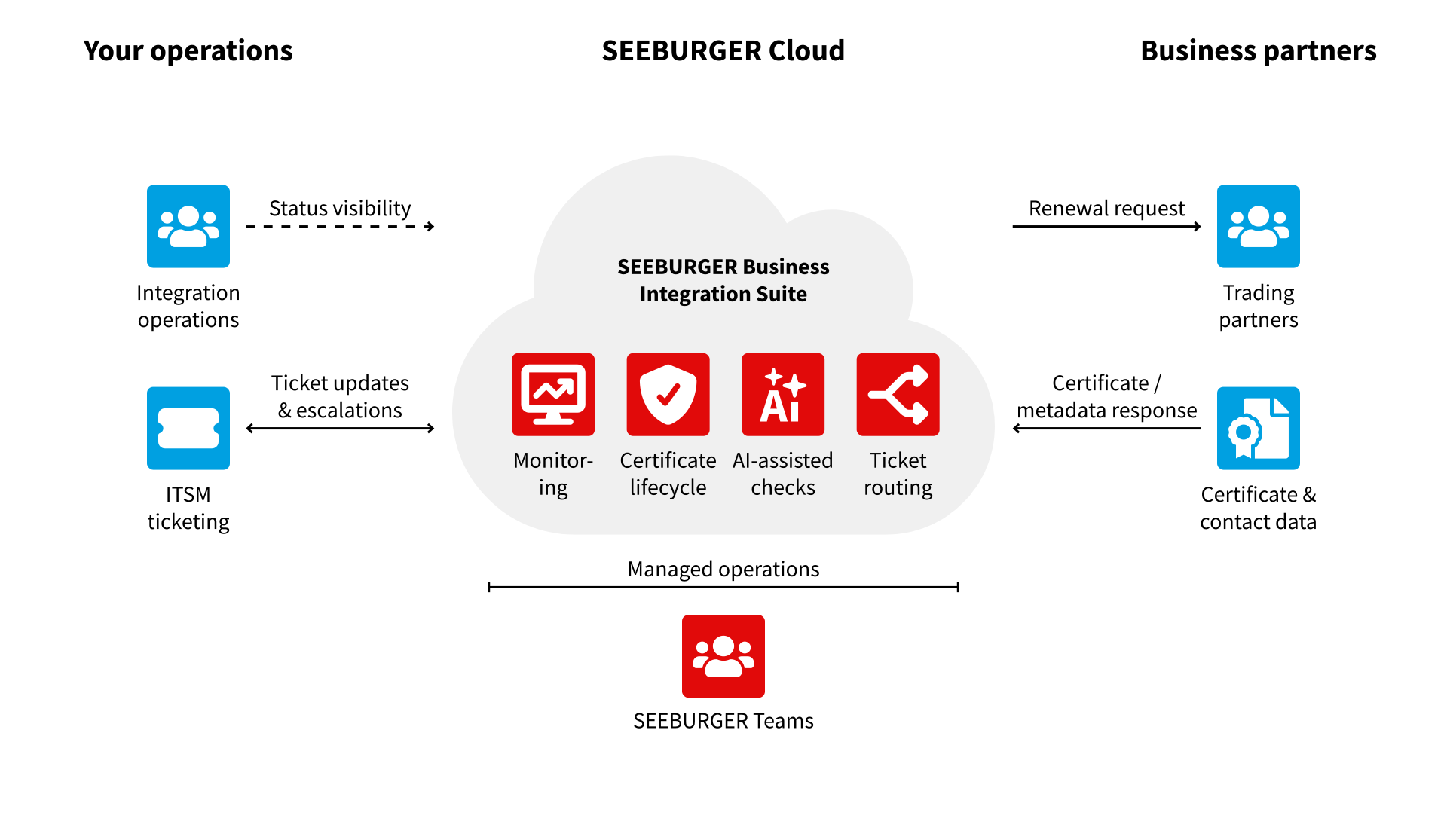
Business impact: lower risk, faster handling and stronger operational resilience
AI-assisted operations help the enterprise manage recurring certificate-related tasks more proactively and consistently. The integration team spends less time on repetitive coordination and more time on exceptions, improvements and critical cases.
The approach delivers:
reduced operational risk around certificate-related connectivity issues
earlier identification of missing partner information
faster preparation of recurring certificate changes
more consistent ticket documentation
fewer manual touchpoints in standard cases
better transparency into escalation status and operational progress
reduced dependency on individual experts for routine coordination
stronger governance through human-in-the-loop decision points
The real shift is from reactive operational effort to proactive operational resilience. Teams spend less time coordinating routine activities and more time improving service quality, reducing risk and supporting business-critical integrations.
From reactive coordination to AI-assisted integration operations
| Before | SEEBURGER approach | Business impact |
| Certificate renewals handled through manual follow-up | Standardized certificate lifecycle management | Earlier and more consistent renewal handling |
| Partner responses reviewed manually | AI-assisted data extraction and completeness checks | Faster preparation of standard cases |
| Ticket quality depends on individual handling | Guided documentation and structured status updates | Better transparency and traceability |
| Routine questions require expert attention | AI-assisted classification, routing and follow-up | Reduced dependency on specialists |
| Automation seen as risky | Human-in-the-loop governance | Controlled automation without losing accountability |
Vision: resilient operations with controlled automation
With AI-assisted operations, the enterprise strengthens integration resilience step by step. Recurring operational tasks become more standardized, transparent and proactive. Experts remain in control of rules, exceptions and approvals, while AI-assisted workflows reduce manual coordination in repeatable scenarios. Over time, the enterprise can extend this model from certificate lifecycle management to other recurring operational use cases such as standard changes, ticket quality assurance, incident routing or guided remediation.
SEEBURGER capabilities in this scenario
This scenario brings together five SEEBURGER capabilities that support AI-assisted and resilient integration operations:
- Business Integration Suite as the foundation for enterprise-wide integration
- B2B/EDI, MFT and API-based integration for secure partner connectivity
- Monitoring and operations capabilities for visibility and control
- AI-assisted workflows for classification, routing, data extraction and guided follow-up
- Human-in-the-loop governance supported by SEEBURGER operational expertise
About this scenario
This scenario is a composite example based on common operational challenges in enterprises with complex B2B, MFT and API-based partner connectivity. It is not a named customer reference and does not describe a single customer implementation. It outlines how enterprises use SEEBURGER to reduce avoidable downtime risks, improve certificate lifecycle management, strengthen operational transparency and introduce AI-assisted operations in a controlled and governed way.
Putting AI-assisted integration operations into practice
Are recurring operational tasks consuming valuable expert capacity or creating unnecessary risk for business-critical partner communication? Discover how AI-assisted integration operations can help your teams reduce manual effort, improve operational visibility and strengthen integration resilience without sacrificing control.
Talk to SEEBURGER about how AI-assisted integration operations can help you standardize certificate lifecycle management, improve ticket quality and keep experts in control of critical exceptions.
FAQ
How can AI-assisted operations help reduce integration downtime risk?
Why is certificate lifecycle management relevant for integration resilience?
Certificates secure partner communication. If a certificate expires or is not exchanged in time, communication with a trading partner can fail. In complex B2B landscapes, certificate renewals are recurring operational tasks that need clear ownership, early visibility and controlled execution.
Do AI-assisted operations mean that certificate changes run fully automatically?
No. In this scenario, AI supports recurring operational steps such as classification, routing, data extraction, completeness checks and documentation. Experts remain responsible for exceptions, approvals and critical decisions.
How is this scenario different from integration maturity or reusable delivery?
Integration maturity focuses on assessing and improving the overall operating model. Reusable delivery focuses on making integration design and implementation more scalable. This scenario focuses on runtime operations: how recurring operational tasks such as certificate lifecycle management can be handled more proactively, transparently and with AI-assisted support.
Which operational processes are best suited for getting started with AI-assisted integration operations?
A practical first step is to identify recurring operational tasks that require significant manual effort or increase the risk of downtime. Certificate lifecycle management is particularly well suited as a starting point because the process is clearly defined, business-critical, and lends itself to standardized workflows with expert oversight.

Related topics
Solution Brief

Discover how SEEBURGER AMS helps reduce operational effort and keep business-critical BIS integration environments running reliably.
SEEBURGER Application Management Services