The Hidden Infrastructure Behind Global Shipping
Why Data Consistency, Process Integrity, and AI-Readiness Depend on Integration
Shipping is becoming digital faster than many integration environments can support. Shipping lines and port operators are investing in automation, real-time visibility, AI-assisted operations, and digital customer services — but these initiatives depend on one often-hidden capability: the ability to move trusted data reliably across partners, systems, and processes.
The maritime industry's digital transformation is well underway. The Digital Container Shipping Association's member carriers have committed to 100% adoption of a standardised electronic bill of lading by 2030, a transition projected to save USD 6.5 billion in direct costs and enable USD 30–40 billion in additional annual global trade1. At the same time, regulatory pressure is intensifying: the EU Emissions Trading System reaches full 100% coverage for voyages involving EU and EEA ports from 1 January 20262, and IMO cyber risk management obligations have sat inside the ISM Code since 2021, requiring cyber risk to be addressed the same way as any other operational risk3. Every one of these shifts increases the volume, variety, and sensitivity of data moving across the maritime ecosystem.
As the number of digital interactions grows across terminals, customs authorities, freight forwarders, trucking companies, rail operators, customers, and internal systems, integration has become a strategic business capability rather than an IT function. The organizations best positioned for the future will be those that establish a consistent integration foundation capable of supporting data consistency, process integrity, and AI-enabled operations at scale.
The challenge behind modern maritime operations
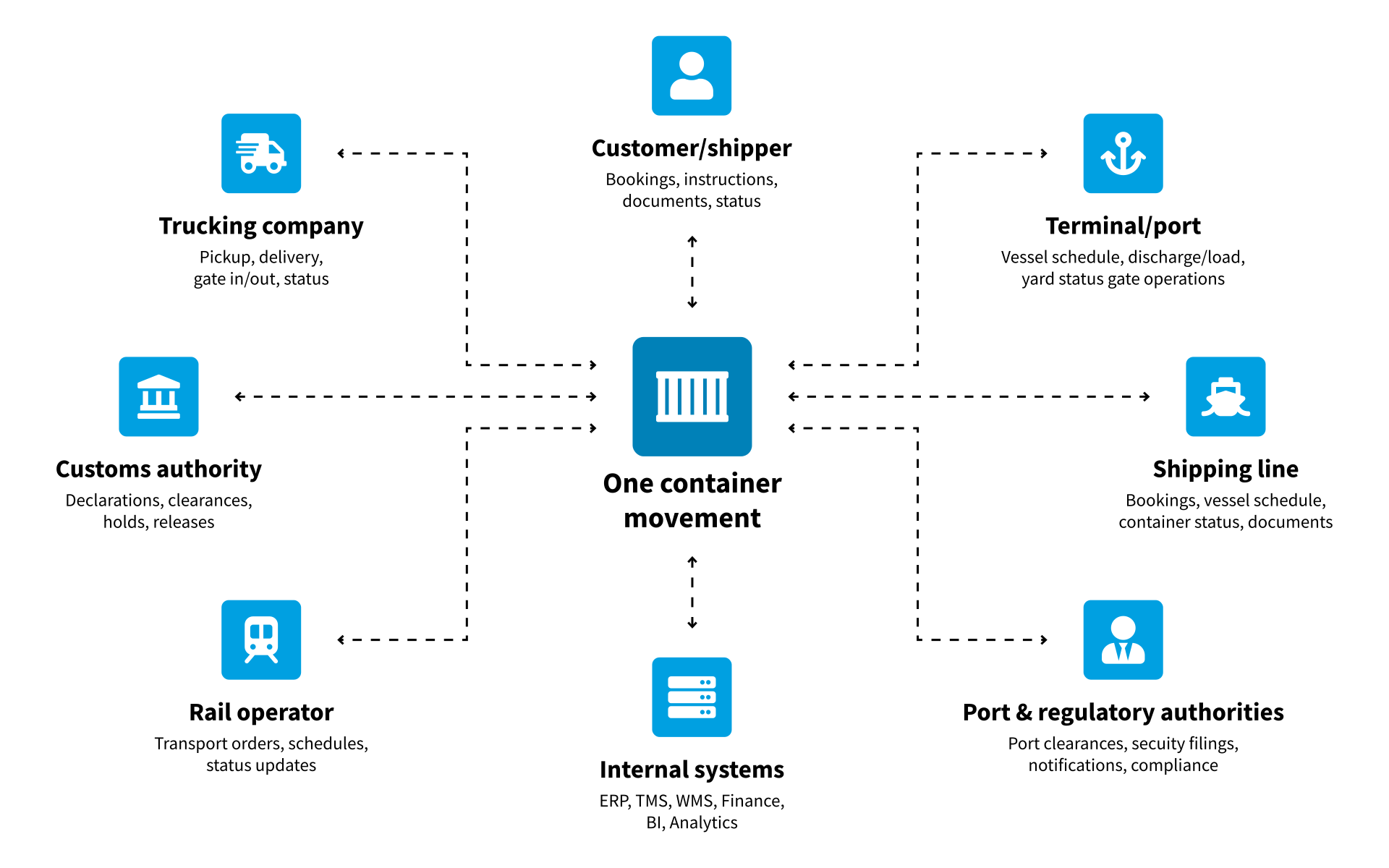
Every container movement generates a series of business events. Bookings, customs clearances, vessel arrivals, gate movements, invoices, release orders, and transport instructions all create data that must move reliably across an extensive ecosystem of partners and systems.
This exchange runs on a structured language that the industry has relied on for decades. UN/EDIFACT messages govern container operations end to end, flowing continuously between shipping lines, terminals, and customs authorities. The volume and variety are the point: this is not a handful of document types but a constant, high-frequency exchange that underpins every vessel call and gate movement.
Why process integrity matters more than ever
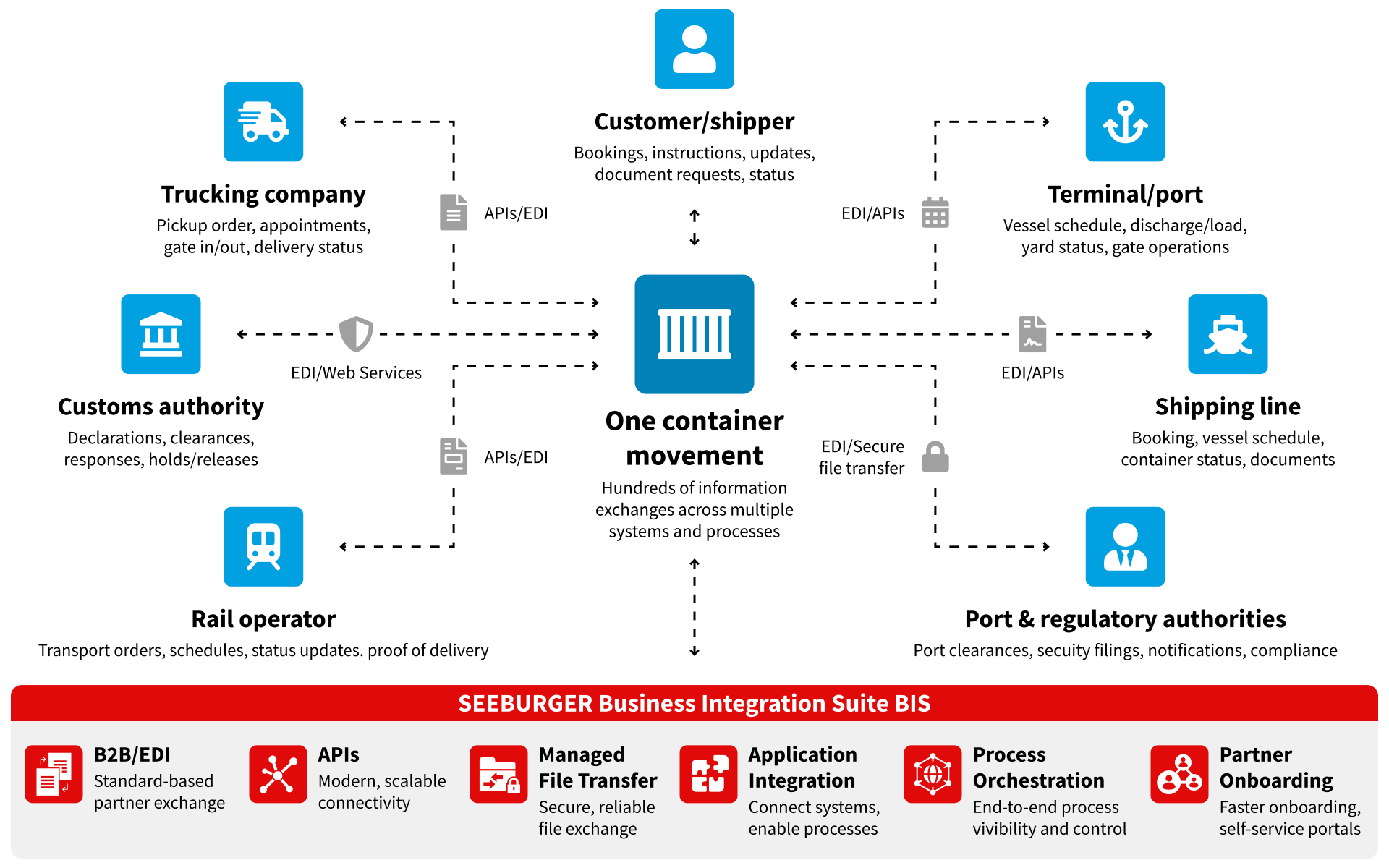
Most shipping and terminal operators have spent years building connections between systems and partners. The result is often a patchwork of technologies supporting B2B/EDI, APIs, managed file transfer, internal application integration, cloud services, and aging legacy platforms.
While these environments may function, they often lack end-to-end process visibility. Organizations can see individual transactions but struggle to understand the complete operational process behind them.
Consider a single booking. It may originate successfully, but downstream validation, customs processing, terminal coordination, and customer notification may occur across multiple disconnected systems. When an exception occurs, identifying the root cause becomes difficult and resolution times increase. The cost is not theoretical: a delayed message can mean a missed gate window, demurrage charges, or a customs hold.
Leading organizations are shifting their focus from connectivity alone to process integrity, ensuring that business processes remain visible, governed, and predictable from beginning to end.
Security is now inseparable from integration
Maritime has become one of the most targeted sectors in the global economy, and the exposure sits squarely in the systems that move data between partners. The numbers are stark.4

Around 31% of maritime professionals reported at least one cyberattack in the twelve months to October 2024, compared with just 17% across the entire five preceding years.5

Transport is now the second most targeted sector in the EU, with maritime and logistics singled out as high-value targets.6

The financial exposure is significant: the average maritime cyberattack costs the target organisation around US$550,000, while the average ransom payment has reached US$3.2 million.7
The operational impact is just as significant as the financial one. When DP World Australia, the country's largest port operator, was forced to suspend operations after a cyberattack, the shutdown lasted three days and delayed more than 30,000 containers across four major ports. Legacy file transfer infrastructure, unmanaged protocols, and ungoverned partner connections are precisely the kind of attack surface that incidents like this exploit.
This is why secure, governed integration is no longer separable from the integration platform itself. End-to-end encryption, access controls, full audit trails, and centralized monitoring across every partner connection are now baseline requirements, not advanced features.
AI is only as good as the integration foundation beneath it
Artificial intelligence is rapidly becoming a strategic priority across the maritime sector. Organizations are exploring AI to improve operational decision-making, predict disruptions, optimize capacity utilization, accelerate exception management, enhance customer service, and automate repetitive operational activities.
However, AI systems require access to consistent, trusted, and timely data. If information remains fragmented across hundreds or thousands of systems and trading partners, AI initiatives struggle to deliver meaningful business value. The reality is that integration readiness is increasingly becoming AI readiness.
According to Gartner, by 2029, 60% of companies will modernize core logistics applications, unlocking AI and integration capabilities previously blocked by obsolete systems.8
The same shift is happening at the platform level. AI-assisted design and productivity features are now common in integration platforms, and vendors are redirecting investment toward AI-driven integration patterns, agent creation and orchestration, and Model Context Protocol enablement. Organizations that can consistently collect, transform, govern, and orchestrate information across their ecosystem will be far better positioned to apply AI effectively.
Industry trends driving integration modernization
Several trends are accelerating the need for a modern integration foundation. Individually, each is manageable. Together, however, they make a fragmented, point-to-point approach increasingly untenable.
These trends include:
Together, these trends are driving a shift toward unified integration platforms capable of supporting multiple integration styles from a single foundation.
What maritime leaders need from integration
As shipping lines and port operators accelerate digital transformation initiatives, integration has become a strategic business capability rather than a technical requirement. Maritime organizations need more than reliable connectivity between systems and partners; they need a foundation that ensures data consistency, process integrity, operational visibility, security, and governance across increasingly complex digital ecosystems.
As the volume of interactions grows across customers, terminals, customs authorities, carriers, trucking companies, rail operators, and internal business systems, organizations must be able to exchange information securely, monitor end-to-end processes, onboard partners efficiently, and maintain compliance with evolving regulatory requirements.
Most importantly, they need trusted, timely, and well-governed data that can support automation, advanced analytics, and AI-driven decision-making. Organizations that establish this foundation will be better positioned to improve operational performance, increase resilience, and capitalize on the next generation of digital and AI-enabled maritime services.
How leading maritime organizations are responding
Ocean Network Express (ONE), one of the world's leading liner shipping companies, operates a highly complex global ecosystem spanning more than 120 countries. To modernize its integration landscape and support continued growth, ONE migrated from a legacy B2B environment to the SEEBURGER Business Integration Suite in the cloud.
Today, the platform supports more than 1.2 million messages per day and 3,030 active partner connections, helping ONE manage the large-scale information flows that underpin modern shipping operations.
As digital demands increase, organizations like ONE are investing in integration foundations capable of supporting both today's operational requirements and tomorrow's AI-driven initiatives.
Building a future-ready integration foundation for modern maritime operations
Unlike point solutions focused on a single integration style, SEEBURGER provides a unified platform for B2B/EDI, APIs, managed file transfer, application integration, process orchestration, and partner onboarding. This enables shipping lines and port operators to modernize operations, streamline partner connectivity, and reduce the complexity that often arises from managing multiple integration technologies.
As digital interactions, regulatory requirements, and ecosystem complexity continue to increase, organizations need more than connectivity. They need a foundation that delivers data consistency, process integrity, operational visibility, security, and governance across thousands of daily partner interactions. By establishing a trusted flow of information across customers, partners, systems, and supply chain networks, organizations can accelerate automation, improve decision-making, and realize greater value from AI-driven initiatives.
For maritime organizations, this means supporting established industry standards such as UN/EDIFACT while enabling modern API-based connectivity, secure data exchange, and end-to-end process visibility across the ecosystem. The result is a future-ready integration foundation that supports today's operational requirements while preparing organizations for the next generation of data-driven and AI-enabled maritime services.
Preparing for the next generation of maritime operations
The future of maritime operations will depend increasingly on the ability to turn information into action. Organizations pursuing AI, automation, and digital ecosystem expansion must first ensure that the underlying integration foundation can support these initiatives.
The question is no longer whether shipping lines and port operators need integration. The question is whether their integration strategy is prepared to support the next generation of operational intelligence.
Interested in reading the Ocean Network Express case study or speaking with the SEEBURGER team about your environment?

2 UK P&I Club, “EU ETS and Shipping from 1 January 2026,” 2026.
European Commission, Climate Action, “Reducing Emissions from the Shipping Sector.”
3 International Maritime Organization, Resolution MSC.428(98), “Maritime Cyber Risk Management in Safety Management Systems,” adopted 16 June 2017, in force 1 January 2021.
IMO, “Maritime Cyber Risk.”
5 DNV Cyber, Maritime Cyber Priority 2024/2025 (survey of 489 maritime professionals, Sept–Oct 2024)
6 ENISA, Threat Landscape 2025 (incidents July 2024–June 2025)