
How a Leading
U.S. Bank Accelerates
Onboarding by 75%
See how the bank streamlined complex onboarding and reduced mapping effort by 70% using SEEBURGER BIS.

Leading U.S. commercial bank
Focused on relationship-driven financial services for mid-sized businesses, this bank provides treasury and cash management including payments and payroll processing, specialty financing and international trade services. It also offers middle-market corporate loans and financing, equipment leasing and more to growing businesses while also offering retail and wealth management services to consumers.
 United States of America
Key results
- Core service: A unified payments gateway engineered for 99.99% availability across multiple AWS regions.
- Automated onboarding: The Community Management Application (CMA) automated the entire workflow, reducing onboarding to less than a week.
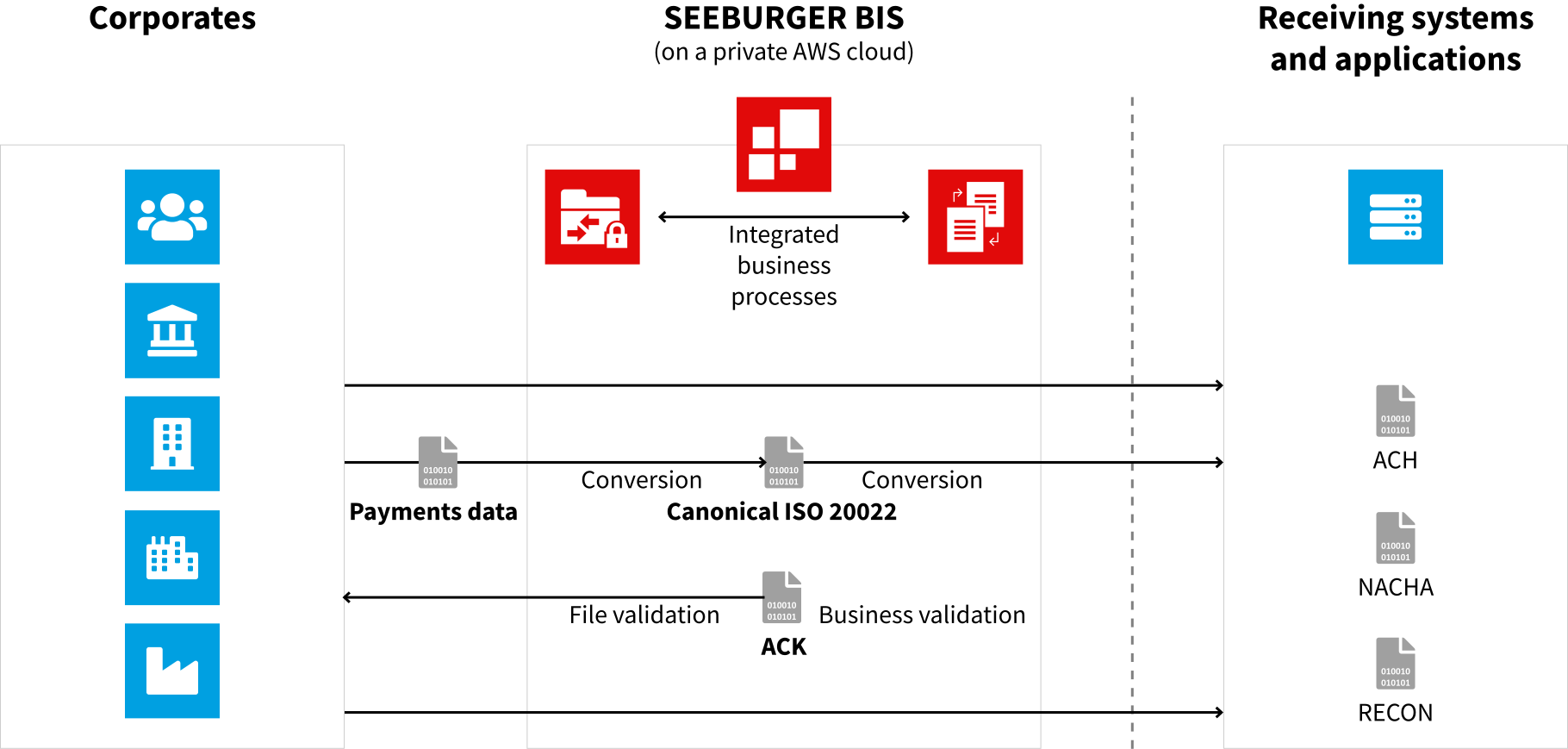
- ISO 20022 readiness: All files are converted into an ISO 20022 canonical format, reducing custom mapping effort by 70%.
- Self-service validation: A portal allows partners to test over 40 payment formats in real time, shifting routine checks upstream and removing technical dependencies.
A large U.S. commercial bank modernized its payments infrastructure by consolidating an unstable, multi-vendor legacy environment into a unified private cloud platform on AWS. By automating onboarding and introducing self-service validation, the bank dramatically reduced partner activation times and created a future-ready foundation for ISO 20022 and payments modernization that enabled it to migrate 7,000 client connections.
Industry
SEEBURGER
products & solutions
Initial situation
For years, payments integration was a critical operational pain point. The bank operated a 'spaghetti' network of disconnected systems stitched together from legacy file transfer and manual translation tools. These systems were unstable, required constant manual intervention, and forced operations teams into a continuous cycle of 'firefighting' on nights and weekends.
Challenge
The manual onboarding and file testing processes were highly inefficient and frustrated both customers and bank staff.
This fragmented ‘spaghetti’ architecture became a critical operational bottleneck that hindered commercial growth, failed to meet the bank’s strategic mandate for cloud modernization on AWS, and lacked the technical agility required for the global regulatory transition to ISO 20022.
Strategic decision: Payments modernization as a strategic growth catalyst
Facing the end-of-life for legacy file transfer systems and a strategic mandate to migrate to a cloud-first infrastructure, the bank decided to replace its fragmented architecture with a single, future-proof integration platform, SEEBURGER BIS, deployed on AWS. This modernized payments ecosystem was defined by:
The bank's intent was to completely redesign its integration landscape, eliminating technical legacy and accelerating time-to-revenue.
Why SEEBURGER: A strategic partner for ISO 20022 excellence and payments modernization
The bank selected us based on our proven track record in complex payment integrations and deep expertise in ISO 20022. This choice was driven by a collaboration model built on trust, where SEEBURGER was chosen to be a solution partner and not just a product vendor. We provided a single-platform architecture capable of handling onboarding, validation, and transformation together, moving the bank away from 'project thinking' toward a long-term partnership for ongoing payments innovation.
Solution
We replaced the legacy stack with the SEEBURGER BIS deployed on a private AWS cloud.
Benefits
The bank has successfully transformed its end-to-end partner onboarding journey by replacing manual coordination with automated workflows powered by the SEEBURGER Community Management Application (CMA).
Previously time-consuming tasks – including Salesforce ticket monitoring, data collection, and certificate exchanges – are now fully automated, while a self-service portal allows partners to independently validate roughly 40 payment formats. This shift enables routine file testing to occur upstream at the partner’s own pace, ensuring the bank’s internal teams only intervene for final activation or complex exceptions.
Operations are now governed by a high-resiliency BIS architecture, engineered for 99.99% availability with multi-region support and automated disaster recovery.
Centralized logging and real-time monitoring provide the bank with granular visibility into every payment flow, which has eliminated the need for manual and reactive troubleshooting.
While the technical integration is now near-instant, the total time-to-revenue depends primarily on partner responsiveness, which is further supported by automated quarterly campaigns to ensure partner contact and entitlement data remain current.
Vision for the future: Driving payments innovation
Today, the bank is actively redefining payments integration as a strategic growth enabler rather than an operational constraint. This modern integration backbone, enabled by SEEBURGER BIS, supports faster change, higher service quality, and a consistently strong experience for both internal teams and customers—positioning the institution to compete and grow in an increasingly real‑time, data‑driven payments landscape.
Building on this foundation, the bank is expanding its capabilities to support the next wave of innovation. Initiatives include extending file validation and testing services beyond payments to commercial use cases, accelerating the transition to ISO 20022 through an expanded canonical model, and enabling API‑driven transfers with fully automated customer onboarding. In parallel, AI‑assisted analytics are being introduced to strengthen fraud detection and AML oversight, while real‑time visibility into file and transaction status is shared directly with external partners. Together, these efforts reflect a clear, ongoing commitment to scalable, intelligent, and customer‑centric payments operations.
The payments modernization initiative serves as a launchpad for sustained competitive advantage, positioning SEEBURGER as a long-term partner in the bank's journey toward intelligent, automated, and resilient payments operations.

Benchmark your corporate client onboarding performance
See how your onboarding processes compare across key areas including connectivity, automation, client activation, and operational efficiency.