AI-assisted integration creates the most value when integration processes are standardized, transparent and governed. Without this foundation, AI can accelerate complexity instead of reducing it. Integration maturity helps enterprises define where automation is useful, where expert oversight remains essential and how AI-assisted capabilities can support scalable operations.

From Manual Integration Operations to an AI-Ready Operating Model
A composite scenario for supply-chain-driven enterprises.
Core challenge
Fragmented integration knowledge, recurring manual effort and strong dependency on individual experts make it difficult to scale integration delivery, automation and AI-assisted operations.
SEEBURGER approach
A governed integration operating model that makes integration knowledge visible, centrally accessible and reusable through standardized processes, reusable integration assets, structured mapping management and improved operational transparency.
Business value
Less duplicated work, lower dependency on individual experts, stronger governance and a controlled foundation for scalable automation and AI-assisted integration.
At a glance
- Operating model shift: From fragmented, expert-dependent integration work to governed and reusable integration knowledge.
- AI role: Assistance for selected onboarding, mapping, analysis and operational tasks, with experts remaining in control.
- Control model: Shared governance, human oversight, structured reuse and stepwise automation.
AI-ready integration becomes possible when organizations stop treating integration knowledge as isolated project expertise. SEEBURGER helps enterprises make mappings, business rules, onboarding knowledge, operational procedures and reusable integration assets visible and governed. This enables teams to improve integration maturity step by step and prepare recurring integration work for scalable automation and AI-assisted support without losing control. AI does not create integration maturity. Integration maturity enables AI.
Industry
SEEBURGER
products & solutions
This success story is relevant for integration leaders who:
- operate complex B2B ecosystems across suppliers, customers, logistics partners and internal business systems
- rely heavily on individual experts for mappings, partner onboarding, monitoring and troubleshooting
- see similar integration work repeated across teams, regions or business units
- need better visibility into existing integration knowledge and reusable integration assets
- want to improve standardization and governance without disrupting established operations
- are preparing their integration landscape for scalable automation and AI-assisted support
Initial situation: integration as a business-critical capability
Supply-chain-driven enterprises depend on reliable information flows across suppliers, customers, logistics partners and internal business systems. Orders, forecasts, shipping notices, inventory updates and invoices must move reliably across increasingly complex B2B ecosystems.
In many organizations, integration landscapes have evolved over years through individual projects, local requirements and business-driven exceptions. While these integrations often work well operationally, the underlying integration knowledge is frequently distributed across teams, systems and individual experts.
Mappings, business rules, onboarding know-how, monitoring procedures and troubleshooting expertise are often difficult to find, validate and reuse consistently across the organization.
As integration volumes grow and automation initiatives expand, organizations face a common challenge:
How can integration knowledge be managed so that automation and AI-assisted operations can scale without increasing complexity or operational risk?
The integration maturity journey
This scenario focuses on the practical transition from Stage 1 and Stage 2 toward Stage 3: Assisted Integration.
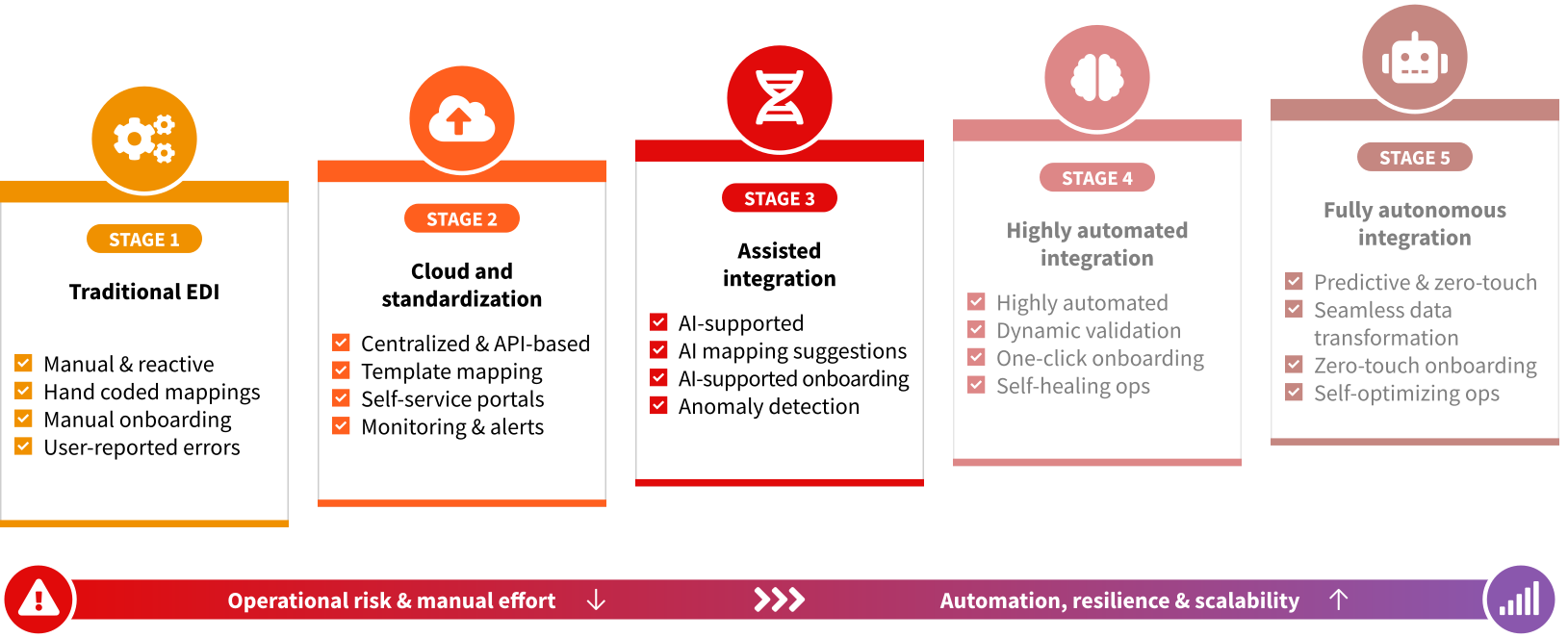
Behind the technology evolution lies a progression in how organizations manage integration knowledge and operations:
Visibility → Centralization → Standardization → Reuse → Automation → AI-Assisted Operations
Integration maturity follows a simple principle:
- Visibility creates understanding.
- Centralization enables governance.
- Standardization enables reuse.
- Reuse enables automation.
- Automation creates the foundation for AI-assisted operations.
As organizations move through these stages, fragmented integration knowledge becomes a reusable enterprise capability. Dependency on individual experts decreases, operational transparency improves and recurring integration work becomes easier to scale and govern.
The focus of this Success Story is the move toward Stage 3, where standardized integration processes and reusable knowledge assets create the foundation for AI-assisted onboarding, mapping support and anomaly detection while experts remain in control.
Challenge: complex and slow integration processes
An enterprise that wants to scale automation cannot treat every integration as a separate project. Repetitive work, fragmented integration knowledge and inconsistent processes increase complexity and slow down transformation.
Typical challenges include:
Substantial manual effort in recurring integration tasks
Strong dependency on individual experts
Limited reuse of proven integration logic
Limited operational visibility
Inconsistent standards and documentationn
Limited foundation for AI-assisted integration at scale

The underlying challenge is often not technology.
The challenge is fragmented integration knowledge.
Strategic decision: centralize and standardize integration knowledge to enable reuse and automation
Rather than starting with AI, the enterprise decides to increase integration maturity first. The goal is to create a centralized and reusable integration knowledge model that allows automation and AI to operate on a reliable and governed foundation. The enterprise treats integration maturity as the practical starting point for scalable automation and AI-assisted operations. The goal is not to introduce fully autonomous integration in one step. The goal is to create a controlled foundation that allows companies to automate where processes are already repeatable, support experts where recurring work creates bottlenecks, and keep humans in control where decisions, exceptions and approvals matter.
This requires a shift in perspective:
From individual integration projects to reusable integration capabilities
From expert-dependent mappings to governed mapping management
From reactive troubleshooting to structured monitoring and error handling
From scattered know-how to reusable assets and documented patterns
From isolated automation to a controlled AI-ready integration model
SEEBURGER solution approach: centralization, standardization, and reuse/automation
SEEBURGER helps the enterprise establish a more mature integration operating model. The approach focuses on standardization, reuse, visibility and controlled enablement for AI-assisted integration.

Centralized Integration Knowledge
Integration knowledge consists of mappings, business rules, onboarding procedures, templates and operational know-how. By managing this knowledge in a shared and governed environment, organizations create transparency, consistency and a foundation for reuse across teams and projects.
With Integrator Workspace as part of BIS Hub, integration flows are designed and managed in a central environment. Teams work with structured projects, flows and reusable components rather than isolated integration implementations. This creates the foundation for governance, reuse and future automation.

Reusable Integration Assets
Reusable assets are the result of well-managed integration knowledge.
SEEBURGER structures reusable integration assets such as connectors, mappings, flow templates and integration patterns into a systematic reuse model that makes proven integration logic available across projects and teams.
This reduces duplicated effort and accelerates the delivery of new integration scenarios.

Modern Mapping and Transformation
Mapping is often one of the areas with the highest expert dependency. SEEBURGER supports a more centralized and maintainable mapping approach.
This improves transparency around mapping logic, reduces reliance on local tools and individual know-how, and prepares the mapping landscape for future AI-assisted capabilities. This helps preserve integration knowledge in a transparent environment.

Monitoring and Operational Transparency
The enterprise also improves visibility into integration operations. Monitoring capabilities help teams understand which flows are active, how they perform and where issues occur.
This establishes a stronger basis for structured troubleshooting, operational governance and future AI-assisted operations. Operational insights become part of the organization's integration knowledge base and can be used to improve governance, troubleshooting and future automation initiatives.

AI-Assisted Integration
AI creates the most value when integration knowledge is transparent, centralized, standardized and reusable. The quality of AI support depends directly on the quality, consistency and accessibility of the underlying integration knowledge. As organizations mature their integration operating model, AI can increasingly support onboarding, mapping, error analysis and operational guidance while experts remain firmly in control. Human oversight remains central. Even in an AI-assisted integration model, experts remain responsible for defining rules, validating results, managing exceptions and approving changes.
Business impact: control, transparency and scalability
This capability enables organizations to:
Reduce structural manual effort
Accelerate new integration scenarios
Improve consistency across mappings and flows
Strengthen operational transparency
Lower dependency on individual experts
Establish a stronger governance model for future AI initiatives
Create a scalable foundation for automation and AI-assisted
The most important outcome is not simply higher automation. It is the transformation of fragmented integration knowledge into a reusable enterprise capability.
This approach does not position AI as a replacement for integration expertise. It creates a model in which AI-assisted capabilities can support skilled teams in a controlled, transparent and scalable way.
Before / action / impact -overview of the SEEBURGER integration maturity approach
| Before | SEEBURGER approach | Business impact |
| Manual partner coordination | Standardized operating model | Faster preparation of recurring integration scenarios |
| Expert-dependent mappings | Modern mapping and reusable assets | Less dependency on individual experts |
| Reactive troubleshooting | Monitoring and operational transparency | Better visibility and structured issue handling |
| Fragmented integration logic | Integration Asset Catalog | More reuse and consistency |
| AI ambition without foundation | AI-assisted integration with governance | Controlled path to AI readiness |
Vision: easy and scalable integration in a controlled environment
With a more mature integration operating model, the enterprise expands automation in a controlled way.
The next priorities include broader reuse of integration assets, more standardized onboarding patterns, stronger operational visibility and selected AI-assisted capabilities for design, mapping and operations.
The long-term direction is clear: integration becomes easier to scale, easier to govern and easier to adapt as business requirements change.
The long-term goal is not autonomous integration for its own sake. The goal is an integration operating model in which integration knowledge is centralized, reusable and continuously enriched, enabling automation and AI to scale without losing governance or control.
SEEBURGER capabilities in this scenario
This scenario brings together several SEEBURGER capabilities that support a more mature, AI-ready integration operating model:
- Business Integration Suite as the foundation for enterprise-wide integration
- BIS Hub and Integrator Workspace for centralized design and governance
- B2B/EDI and application integration for partner and system connectivity
- Integration Asset Catalog for reusable connectors, mappings and templates
- Web-based mapping for more transparent and maintainable transformations
- Monitoring and operations capabilities for better visibility and control
- Accelerator Services for expert guidance and operational enablement
About this scenario
This scenario is a composite example based on common integration challenges in supply-chain-driven enterprises and SEEBURGER solution capabilities. It is not a named customer reference.
It outlines how supply-chain-driven enterprises with complex B2B ecosystems use SEEBURGER to improve integration maturity, standardize recurring work, increase operational transparency and build a controlled foundation for AI-assisted integration.
FAQ
Why does integration maturity matter before scaling AI?
Does AI-assisted integration replace integration experts?
No. In this scenario, AI supports integration experts instead of replacing them. Experts remain responsible for defining rules, validating results, managing exceptions and approving changes. AI-assisted capabilities help reduce repetitive effort, improve consistency and support faster decision-making in selected integration tasks.
Is this approach only relevant for manufacturing companies?
No. The scenario is relevant for all supply-chain-driven enterprises with complex B2B ecosystems. This includes manufacturing, automotive, retail, logistics, CPG, energy and other industries where partner onboarding, mapping, monitoring and operational reliability are business-critical.
Does an AI-ready operating model require a big-bang transformation?
No. The approach is designed as a stepwise path. Enterprises can start by standardizing recurring integration work, improving visibility, reusing integration assets and modernizing selected mapping or monitoring processes. This creates a controlled foundation for AI-assisted integration without disrupting existing operations.
Where should enterprises start?
A practical first step is to identify recurring integration work that creates structural effort. Typical starting points include partner onboarding, mapping changes, troubleshooting, monitoring and reuse of proven integration logic. From there, enterprises can define which processes should be standardized, which assets can be reused and where AI-assisted capabilities can provide additional support.


Related topics
Success Stories

A composite scenario for enterprises with distributed integration demand.
Scaling Integration Delivery Through Reuse and Governance
White Papers

Eliminate fragmentation along the supply chain
Connecting the Supply Chain
