Connecting the
Supply Chain
Why Integration Is the Foundation for
Scalable Automation and AI
Executive summary: From fragmented systems to scalable, integrated supply chain operations
Supply chains are under increasing pressure. Disruptions, geopolitical uncertainty, regulatory demands and rising expectations for speed, transparency, and resilience are forcing organisations to rethink how they operate.
Many are investing in AI, automation and visibility tools. However, these initiatives often fail to scale and day-to-day operations remain unchanged. The reason is not a lack of technology, but a lack of integration between systems, partners and data.
As a result:
Automation remains limited |
AI lacks reliable, |
Visibility remains |


To address this, organisations need a connected supply chain – linking systems, partners, and processes end to end, without manual data transfers. This requires a consistent integration approach that ensures reliable data flows, centralized tracking and governance, and end-to-end coordination across the supply chain.
This requires a consistent integration approach that ensures reliable data flows, centralized tracking and governance, and end-to-end coordination across the supply chain.
With this foundation in place, organisations can:
Introduction: From ERP systems to connected supply chain networks
Supply chains have evolved beyond isolated enterprise systems. Traditionally, organisations relied on ERP systems as the backbone of their operations, supported by point-to-point integrations with suppliers, logistics providers, and customers.
Today, this model no longer reflects how supply chains operate.
Modern supply chains operate as interconnected networks involving multiple internal systems, external partners, and digital platforms. Organisations must coordinate across suppliers, logistics providers, customers, and regulatory bodies – often across regions, systems, and formats.
This shift from one-to-one connections to multi-party ecosystems significantly increases integration complexity. Each additional partner, system, or requirement introduces new interfaces, dependencies, and data formats.
At the same time, supply chains are under increasing pressure – from disruptions and geopolitical uncertainty to growing regulatory demands and rising expectations for speed, transparency, and resilience.
Supply chain owners are expected to:
- Respond quickly to disruptions
- Provide timely and reliable visibility
- Automate processes across organisational boundaries
- Ensure compliance with growing regulatory requirements
To meet these expectations, many organisations invest in AI, analytics, and automation. In fact, Gartner estimates that by 2028, 80% of warehouses and distribution centres will deploy some form of warehouse automation1. However, without a connected foundation, none of these technologies can deliver their full potential.
This creates a growing gap between ambition and operational reality – one that cannot be solved by adding more tools alone.
The reality of fragmented supply chains
For many supply chain teams, these challenges are not theoretical – they define daily operations.
Data is pulled together from multiple systems, often in different formats and with varying levels of quality. Information is manually checked and reconciled, frequently using spreadsheets. Missing data must be chased across partners, and onboarding new suppliers or logistics providers often requires manual coordination and custom integration work.
When processes break, teams step in to resolve issues themselves.
| 01 | A supplier may confirm that a shipment has left the factory, yet it fails to arrive as expected. The issue may occur with a logistics provider or at customs, but there is no clear visibility into what has gone wrong or where the delay occurred. |
| 02 | By the time the problem is identified, downstream operations are already affected. Production schedules must be adjusted, and teams are forced into reactive problem – solving. |
This is how fragmented supply chains operate. When systems are not properly connected, delays and inconsistencies are not exceptions – they are built into the process. In response, organisations invest in new technologies to improve performance. However, without addressing the underlying structure, these initiatives rarely deliver their full potential.
AI, automation, and visibility all depend on the same condition: integrated systems that enable consistent data flows and end-to-end coordination across the supply chain.
The root cause: fragmented systems and data
Across all these challenges, a consistent pattern emerges. The root cause is not the absence of technology, but the fragmentation of systems, data, and processes.
Most organisations already have the systems they need in place. However, these ERP and other systems were often implemented independently and are not designed to operate as part of a connected environment.
At the same time, partner ecosystems introduce additional complexity. Suppliers, logistics providers, and customers operate across different systems, formats, and standards. Each connection requires coordination, mapping, and ongoing maintenance.
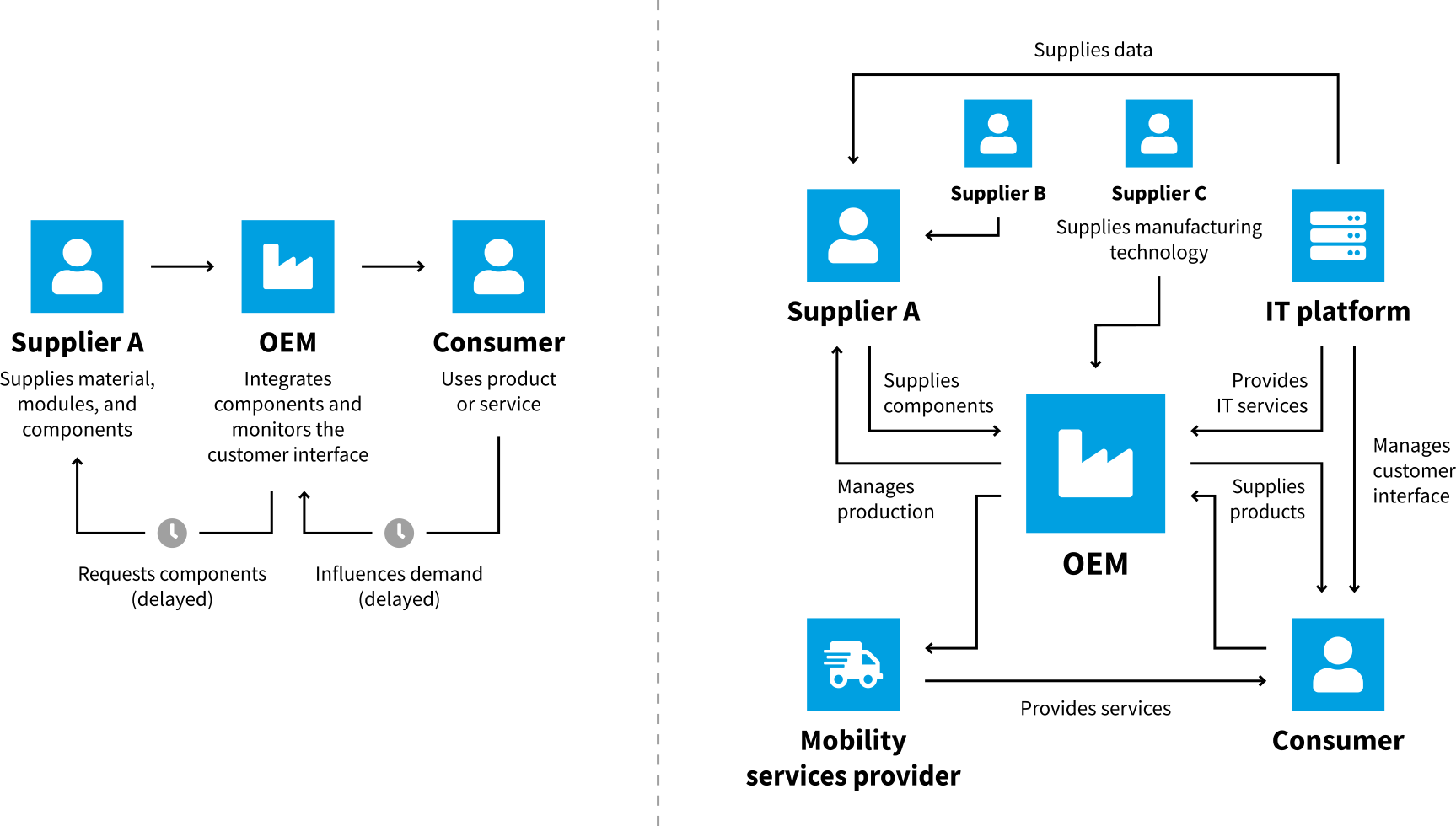
As a result, processes break at system and organisational boundaries. Data becomes inconsistent or delayed, and manual intervention is required to keep operations running.
This fragmentation increases complexity, slows decision-making, and raises operational risk. It also makes compliance significantly more difficult. Regulations across the EU, US and UK – such as the EU Corporate Sustainability Due Diligence Directive, the Electronic Freight Transport Information Regulation (eFTI4EU), the US Uyghur Forced Labor Prevention Act and the UK Modern Slavery Act – are making supply chain transparency and traceability mandatory. Organisations must be able to demonstrate where products come from, how they move, and how suppliers comply – often across multiple systems and regions.
Without a connected foundation, the supply chain reporting remains manual, increasing risk, and operational effort.
Addressing this root cause requires a consistent integration approach that connects systems, partners, and data into a unified and reliable framework.
What leading organisations do differently in their supply chains
Leading organisations take a different approach. Instead of adding new tools on top of existing complexity, they focus on creating a stable and connected foundation.
They establish consistent ways to connect systems, partners, and data across the supply chain. Rather than building point-to-point integrations, they standardize how data flows between ERP systems, logistics providers, suppliers, and internal applications.
They also introduce governance into data flows – defining how data is structured, validated, and shared. This ensures consistency and trust in the data, while enabling processes to run seamlessly across system and organisational boundaries.
This approach reduces complexity and creates a stable foundation for automation and AI – supporting established applications such as demand forecasting and warehouse automation, as well as use cases like predictive disruption management, advanced optimisation, and agentic AI, many of which Gartner1 identifies as still evolving in maturity and scalability.
As integration matures, organisations begin to see measurable operational impact. Standardized data flows and shared visibility reduce manual coordination, accelerate partner onboarding, and shift operations from reactive status checks towards more predictable, event-driven processes.
At the same time, connected and consistent data enables earlier detection of disruptions and more informed decision-making. AI and analytics initiatives can move beyond isolated pilots, while traceability, compliance and auditability become embedded into operational processes rather than managed through manual reporting.
Taken together, these examples show why leading organisations treat integration as a core operational capability. A stable, governed foundation connecting systems, partners, and data end‑to‑end enables improvements across operations, IT, data and analytics, and compliance – without requiring the architecture to be rebuilt for each new initiative.
A connected supply chain enables successful operations
A fully integrated supply chain does more than improve processes – it delivers measurable business impact:

Lower
operational costs
by eliminating manual work, delays, and inefficiencies

Faster
execution
across systems and partners, reducing cycle times

Greater
reliability
by minimizing errors and disruptions

More resilient operations
that can adapt to change
The role of an integration platform for end-to-end supply chain integration
In practice, this approach is enabled by an integration platform that combines multiple capabilities – such as EDI, APIs, and Managed File Transfer – within a single, consistent framework. This allows organisations to handle different integration scenarios effectively while maintaining control and visibility.
This includes support for industry standards and formats, enabling consistent and compliant data exchange across partners and systems.
At the same time, a multi-capability integration platform provides centralized monitoring, process-level tracking, and governance across all data flows. This ensures transparency and consistency, even when processes span multiple systems, partners, and company boundaries.
Once this foundation is in place, the impact becomes visible across multiple areas.
From ambition to execution: building an integrated supply chain
Moving from a fragmented environment to a connected supply chain does not require a complete transformation overnight. Progress can be made step by step, starting with partner-centric areas where fragmentation has the greatest operational impact.
However, isolated improvements are not enough. To fully realize the value of automation, AI, and compliance initiatives, organisations need a consistent, end-to-end integration foundation across their supply chain.
This means connecting systems, partners, and data flows in a way that allows processes to run seamlessly across organisational and technical boundaries – without manual data transfers.
By addressing this foundation early, organisations avoid having to rebuild their architecture with each new initiative. Instead, they create a stable environment that supports continuous improvement.
The result is a supply chain that can scale, adapt, and evolve over time.
How SEEBURGER supports you
The SEEBURGER Business Integration Suite is an integration platform that enables organisations to connect systems, partners, and processes across different integration scenarios, systems, and formats in complex supply chain environments.
With deep roots in EDI and B2B integration, combined with comprehensive API-based approaches and robust managed file transfer (MFT) capabilities, SEEBURGER supports a wide range of integration scenarios within a single, governed framework – whether on premises, hybrid or in the cloud. This contrasts with API only or tool sprawl approaches by enabling organisations to manage business-critical supply chain processes reliably across internal systems and external partners.
In practice, organisations use the SEEBURGER BIS to standardize partner onboarding, manage high-volume operational data flows, and maintain visibility across suppliers, logistics providers, and internal systems. Critical processes such as order fulfilment, shipment tracking, supplier collaboration, and compliance reporting can run reliably within a single environment across system and organisational boundaries.
By creating consistent, connected data flows, organisations gain the foundation required for scalable automation, real-time visibility, and AI-enabled decision-making. Events across systems and partners can be monitored and correlated more effectively, allowing disruptions to be identified and addressed earlier, before they impact downstream operations.
The platform also supports governed AI-assisted and agentic capabilities within business processes, enabling tasks such as validation, routing, and exception handling to be executed automatically while maintaining operational control, traceability, and compliance.
SEEBURGER is proven at scale, particularly in highly regulated industries where reliability, auditability, and data consistency are business critical.
In practice, organisations use the SEEBURGER BIS to:
Read how a global manufacturer improved visibility, stability, and process efficiency with the SEEBURGER BIS in our Superior Industries case study.



1 Source: Gartner(2026) Hype Cycle for Supply Chain Execution and Logistics Technologies