
Ireland’s B2B
E-Invoicing Mandate:
From Compliance Deadline to Finance Process Value
With Phase One starting on November 1, 2028, now is the time to understand Ireland’s confirmed VAT Modernization requirements and build an e-invoicing foundation that supports compliance, automation, and long-term process efficiency.
Ireland’s B2B e-invoicing mandate marks a major shift in how businesses create, exchange, process, and report VAT-relevant invoice data. Under Revenue’s VAT Modernization program, the first in-scope organizations must adopt structured B2B e-invoicing and real-time reporting for domestic transactions from November 1, 2028. Further phases will follow in 2029 and 2030, aligning Ireland with the EU’s VAT in the Digital Age (ViDA) requirements.
For businesses, the mandate is more than a compliance deadline. It requires a move from document-based invoicing toward structured, system-to-system data exchange. Organizations that delay preparation may have limited time to assess scope, clean VAT-relevant data, test ERP and partner integrations, define exception workflows, and adapt once Revenue publishes final technical specifications.
The real business value lies in what happens before and after an e-invoice is sent or received. Invoice data must be accurate before exchange, validated before processing, integrated into ERP and accounting systems, routed through approval and matching workflows, reported where required, monitored throughout the lifecycle, and archived for audit readiness. Without this end-to-end integration, businesses may become technically ready to exchange e-invoices while still carrying the same process inefficiencies.
Structured e-invoicing creates a strong foundation for automation. When invoice data is machine-readable, pre-validated, and integrated into downstream systems, businesses can reduce manual handling. Industry benchmarks indicate that organizations adopting structured e-invoicing and invoice automation can reduce manual invoice handling by 60–80%, while also improving approval cycles, VAT data quality, process visibility, and operational control.
With final Irish technical specifications still pending, businesses need a scalable solution that supports confirmed requirements while remaining adaptable as Revenue publishes further guidance.
Ireland’s move toward structured e-invoicing
Ireland’s VAT Modernization program will change how businesses create, exchange, report, and process VAT-relevant invoice data. From 1 November 2028, the first in-scope organizations must adopt structured B2B e-invoicing and real-time reporting for domestic transactions.
At its core, the mandate is about two connected requirements: structured e-invoicing and real-time reporting. Instead of relying primarily on periodic, aggregated VAT reporting, businesses in scope will need to exchange structured invoice data electronically and report a subset of relevant e-invoice data to Revenue.
While the mandate is often viewed as a compliance obligation, its impact reaches further into finance and IT operations. Preparation needs to cover the data, systems, processes, and responsibilities that determine whether structured invoices can be exchanged, reported, and processed reliably.
Early preparation helps businesses reduce implementation risk while building a scalable e-invoicing foundation for Ireland, ViDA, and future global mandates. Done well, mandate readiness can also support better invoice data quality, greater automation, and more efficient end-to-end finance processes.
Two requirements, one direction: structured VAT data
At a glance: what’s changing
1. From document-based invoices  structured data exchange
2. From periodic VAT returns transaction-level reporting
3. From disconnected systems integrated finance ecosystems
4. From national compliance EU-wide alignment (ViDA)
Structured e-invoicing: from documents to usable data Ireland’s mandate will require businesses in scope to exchange invoices as structured electronic data that systems can process automatically. For Phase One, Revenue has confirmed EN16931 as the required standard and has clarified that PDFs and scanned paper invoices are not structured e-invoices. | Real-time reporting: from periodic summaries to timely VAT visibility Businesses in scope will also need to report a subset of relevant e-invoice data to Revenue. Instead of relying primarily on periodic, aggregated VAT reporting, the mandate brings VAT-relevant transaction data closer to the point where invoices are created, exchanged, and processed. Final technical details are still to be confirmed by Revenue. |
What Ireland aims to achieve
Ireland’s VAT Modernization program is not simply a change in invoice format. Revenue frames it as a move toward more timely, structured, and system-based VAT reporting that helps businesses report the correct VAT at the correct time while reducing errors, manual work, and fraud.
The program also aligns Ireland’s VAT reporting with the EU’s ViDA framework, modern international practice, and the way many businesses already use digital systems to manage sales, purchases, and payments. In practice, this means structured e-invoicing, real-time reporting, integration with modern business systems, and preparation for EU-wide digital VAT requirements increasingly belong together.
This means the mandate will affect more than tax reporting alone. It will influence how finance, tax, IT, accounts payable, accounts receivable, procurement, and ERP teams manage invoice data and process controls.
The mandate’s scope: who is affected?
Ireland’s B2B e-invoicing mandate will not affect all businesses in the same way at the same time. The confirmed rollout is phased, with the first issuing obligation applying to a defined group of large corporates. However, the impact will also extend to businesses that need to receive structured e-invoices from in-scope suppliers.
For Phase One, Revenue defines large corporates as VAT-registered businesses whose tax affairs are managed by Revenue’s Large Corporates Division and that are established, or have a fixed establishment, in Ireland. These businesses are the first group required to issue structured e-invoices for domestic B2B transactions and report a subset of relevant e-invoice data to Revenue.
The receiving side is broader. Revenue has confirmed that, in Phase One, all businesses in Ireland must be able to receive and process structured e-invoices from suppliers that are mandated to issue them. “All businesses in Ireland” is not further defined in this specific receiving requirement. Therefore, businesses must evaluate their exposure based on their Irish operations, supplier relationships, VAT position, and whether they receive invoices from suppliers that fall under the mandate.
The mandate will later extend to VAT-registered businesses engaged in cross-border EU B2B trade, subject to zero-rate VAT arrangements. In addition, businesses involved in relevant cross-border EU B2B transactions will need to prepare for the EU-wide ViDA requirements.
Key due dates of the Irish B2B e-invoicing mandate
Ireland will introduce VAT Modernisation in phases. Revenue has confirmed the following timeline.
| November 1, 2028 | November 1, 2028 | November 2029 | July 2030 | |
| Confirmed milestone | Phase One begins with mandatory e-invoicing and real-time reporting for domestic B2B transactions. | All businesses in Ireland must be able to receive structured e-invoices from suppliers that are mandated to issue them. | Phase Two begins: the domestic obligation extends to VAT-registered businesses engaged in cross-border EU B2B trade, subject to zero-rate VAT arrangements. | ViDA requirements become mandatory for cross-border EU B2B transactions across EU Member States. |
| Who is affected? | VAT-registered large corporates whose tax affairs are managed by Revenue’s Large Corporates Division and that are established, or have a fixed establishment, in Ireland. | All businesses in Ireland receiving invoices from in-scope suppliers. | VAT-registered businesses engaged in relevant cross-border EU B2B trade. | Businesses involved in relevant cross-border EU B2B transactions. |
Phase One is therefore the first date businesses need to plan around. Even organizations that are not required to issue e-invoices in Phase One may still be affected from 1 November 2028 if they receive invoices from suppliers that are mandated to issue structured e-invoices.
The emerging technical model: Peppol as an important reference point
Ireland has not yet published the final technical architecture for B2B e-invoicing and real-time reporting. Details such as transmission channels, reporting interfaces, validation processes, and operational specifications are still to be confirmed by Revenue.
However, Peppol is already an important part of Ireland’s e-invoicing landscape. The new system shall use various existing technical infrastructures, including the Peppol framework. Ireland already uses a Peppol-supported 4-corner model in the public-sector B2G e-invoicing context. For the upcoming B2B mandate, Revenue has identified Peppol as one of the existing infrastructures expected to support wider e-invoicing adoption, but the final B2B architecture – including whether it will follow a 4-corner, 5-corner, or another model – has not yet been confirmed by Revenue.
Ireland’s confirmed approach combines structured e-invoicing with real-time reporting of selected invoice data to Revenue. Functionally, this points toward a 5-corner model, because Revenue becomes an additional reporting recipient. However, Revenue has not yet published final technical specifications or explicitly confirmed the 5-corner model.
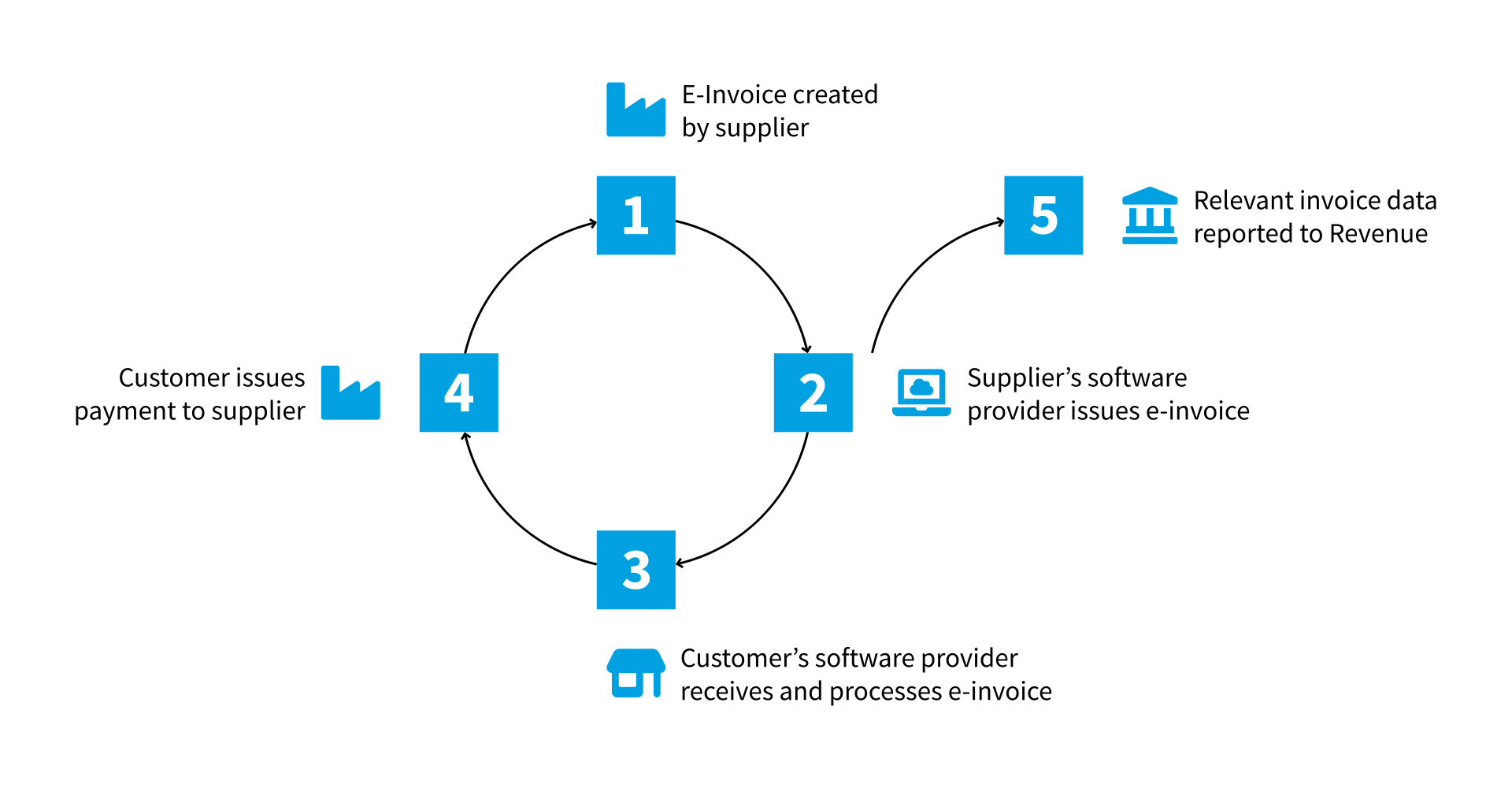
For businesses, this means Peppol should be treated as a key readiness area, but not yet as the only confirmed model for the B2B mandate. Until Revenue publishes the final specifications, companies should avoid hard-coding assumptions around one transmission channel or operating model.
The practical focus should be on building capabilities that remain relevant regardless of the final architecture: EN16931-ready invoice data, inbound and outbound e-invoicing capability, ERP integration, data validation, monitoring, exception handling, and readiness to report the required invoice data to Revenue once the technical specifications are confirmed.
Business implications: compliance is only the starting point
From post-processing control to real-time data ownership
Structured e-invoicing shifts control upstream. Invoice data must be accurate before submission rather than corrected afterwards, making data quality and validation central to finance operations.
Ireland’s B2B e-invoicing mandate will require businesses to exchange and process structured invoice data. But from a business perspective, the real challenge is not simply getting an e-invoice into the system. Invoice data must be correct before it is sent, usable when it is received, and connected to the processes that follow.
This makes mandate readiness a broader business transformation issue.
The mandate raises the pressure on invoice process control
Structured e-invoicing shifts control upstream. Invoice data must be accurate before exchange, usable when received, and connected to the processes that follow: validation, approval, matching, posting, reporting, archiving, and exception handling. This makes mandate readiness a business transformation issue, not only a compliance or IT implementation task.
- Invoice data quality becomes a critical control point
Structured e-invoicing depends on accurate invoice and VAT-relevant data from the start. Finance teams need stronger control over tax codes, VAT IDs, supplier and customer master data, purchase order references, invoice totals, and other mandatory fields before invoices are exchanged or reported. - Receiving an e-invoice is not the same as processing it
A structured invoice still needs to move through business processes. It must be validated, matched, approved, posted, paid, archived, and made available for audit or reporting. If those steps remain manual or fragmented, businesses may become technically ready for e-invoicing while still carrying the same operational inefficiencies. - Exceptions can slow down the entire finance process
E-invoicing can make missing or inconsistent data visible earlier. That is valuable, but only if finance teams have clear workflows to resolve exceptions quickly. Without defined ownership, rejected invoices, matching issues, missing references, or incorrect tax data can become new bottlenecks. - Compliance evidence depends on process visibility
Finance teams will need transparency over invoice status, processing status, reporting status, and unresolved exceptions. Without end-to-end visibility, it becomes harder to prove that invoices were handled correctly, identify where processes break down, or manage performance across AP, AR, and tax.
The mandate exposes integration gaps
For IT teams, the mandate is not just about supporting a new invoice format. It requires a connected architecture that can move structured invoice data reliably between ERP, finance, procurement, tax, reporting, workflow, archive, and partner systems. The more fragmented the current landscape is, the harder it becomes to support e-invoicing at scale.
- Existing systems may not create or consume compliant invoice data easily
Many businesses run multiple ERP systems, billing tools, procurement platforms, and finance applications. IT teams need to ensure that invoice data can be extracted, mapped, transformed, validated, transmitted, received, and processed in the required structured format. - Pre- and post-e-invoicing processes are often disconnected
The e-invoice exchange sits in the middle of a longer process. Before exchange, systems need correct master data, tax logic, document generation, and validation. After exchange, invoices need to flow into matching, approval, posting, payment, reporting, and archiving processes. If these steps are not integrated, the mandate can expose process breaks rather than solve them. - One-off country solutions create long-term complexity
Ireland is part of a wider shift toward e-invoicing and digital reporting, including ViDA. Solving each national mandate with a separate local setup can create technical debt, duplicated integrations, inconsistent monitoring, and higher maintenance effort. - Flexibility matters while final specifications are still pending
Revenue has confirmed the direction of the mandate, but detailed technical specifications are still to be published. IT teams therefore need an approach that supports confirmed requirements while remaining adaptable for final transmission channels, reporting interfaces, validation rules, and operational processes.
Finance and IT need one end-to-end operating model
The mandate will not be successful if finance and IT prepare in isolation. Finance owns the business meaning of invoice and VAT data. IT enables the systems, integrations, controls, and monitoring that move this data through the organization. The critical question is how both teams will manage the full invoice lifecycle together.
- Ownership across the invoice lifecycle is often unclear
E-invoicing involves more than sending and receiving invoices. Businesses need clear ownership for master data, supplier and customer onboarding, validation rules, exception handling, status monitoring, reporting, and archiving. Without defined responsibilities, problems can fall between finance, tax, procurement, and IT. - Data governance becomes a business-critical capability
Structured e-invoicing increases the importance of clean, consistent, and complete data. Finance knows what the data must mean from a business and tax perspective. IT ensures that this data is available, structured, mapped, and exchanged correctly. Both sides need shared rules for maintaining data quality before automation scales existing errors. - Mandate readiness needs to support future change
Ireland’s mandate should not be treated as an isolated compliance project. Businesses need a model that supports the confirmed Irish requirements while preparing for ViDA and future national mandates. This requires cross-functional decisions on architecture, process ownership, monitoring, and long-term scalability.
Beyond compliance: turning structured invoice data into process value
Organizations adopting structured e-invoicing typically achieve:
 60–80% reduction in manual invoice handling1
Faster approval cycles (often reduced by several days)
Significant improvement in VAT data accuracy
Ireland’s mandate sets the compliance direction: businesses need to prepare for structured e-invoicing and real-time reporting. But once invoice data is structured, the question quickly becomes bigger than compliance. How can that data improve the way invoices move through processes?
This is where the business value of Ireland’s mandate begins. Structured invoice data creates the foundation for automation, but only if it is connected to the systems that validate, process, approve, post, report, and monitor invoices every day.
Many organizations already handle “digital invoices” in ways that still behave like paper: PDF attachments, portals, manual checks, and rekeying. The result is avoidable friction in Accounts Payable, Accounts Receivable, tax, and downstream finance processes. Ireland’s move toward structured e-invoicing gives businesses a clear opportunity to address this friction at the source.
| Pain point | Resulting inefficiency | Key concern |
| Slow processes | Delays from invoice receipt to verification, approval, matching, and posting in the ERP slow down finance operations. | Invoices get stuck waiting for validation or approval, creating bottlenecks across AP and AR. |
| High error rate | Manual review and entry increase the risk of incorrect invoice data, VAT-relevant errors, payment delays, and supplier or customer friction. | Incorrect or incomplete data can affect both invoice processing and VAT reporting readiness. |
Structured e-invoicing addresses these issues by making invoice data consistent, machine-readable, and validation-ready. When this data is integrated into ERP and accounting environments, AP and AR teams can automate checks, route exceptions, and process invoices based on structured information instead of rebuilding invoice data by hand.
- Faster processing from receipt to posting
Integrated e-invoicing helps invoice data move directly into validation, approval, matching, and posting workflows. This reduces the risk that structured invoices are received technically but still get stuck in manual downstream processes. - Fewer corrections through pre-validation and better invoice data quality
Pre-validation checks invoice and VAT-relevant data before it moves further through the process. This helps identify missing, inconsistent, or incorrect information before invoices are exchanged, processed, reported, or archived. As a result, finance teams can reduce manual checks, rekeying, avoidable corrections, and downstream exceptions. - More focus on exceptions, less time spent on routine work
When standard checks and routing steps are automated, finance teams can spend less time on repetitive processing and more time resolving exceptions that require business judgment, supplier or customer communication, or control review. - Greater visibility across the invoice lifecycle
Structured data, pre-validation, monitoring, and integration improve transparency from invoice creation or receipt through to posting, reporting, and archive. This gives finance and IT a stronger basis for compliance evidence, audit readiness, and process performance.
How SEEBURGER can help
While November 1, 2028 may still seem distant, organizations benefit from preparing early. Ireland’s mandate requires more than replacing PDFs with structured invoices. Businesses need a foundation for compliant e-invoicing, reliable data exchange, integration into existing systems, and automated processing across the invoice lifecycle.
SEEBURGER supports Finance and IT with a standards-first approach that helps organizations prepare for confirmed requirements while remaining flexible as Revenue publishes further technical specifications. At the same time, SEEBURGER enables businesses to go beyond compliance by connecting e-invoicing to ERP, SAP, accounting, procurement, tax, archive, and reporting processes.
Learn how an international healthcare supplier meets global compliance mandates with SEEBURGER Cloud Integration Services for EDI & E-Invoicing.


Learn how the SEEBURGER E-Invoicing Hub helps you ensure compliance and automate your invoicing processes efficiently. Country-specific requirements, Peppol connectivity and seamless integration with SAP are at the core.

Get ready for the UK’s 2029 shift to structured e-invoicing. See what’s confirmed, what’s still open, and how Finance and IT can align early to reduce risk and enable automation.

Discover how to turn Peppol connectivity into integrated, automated, and scalable end-to-end e-invoicing processes.