
Spain’s
E-invoicing Mandate:
Your Roadmap to Readiness
What Finance and IT need to know about the October 2027 planning milestone, Spain’s likely 5-corner model, invoice lifecycle statuses, and ERP integration.
Spain’s mandate: structured invoices, platform exchange, and payment transparency
Spain’s B2B e-invoicing mandate is part of a broader effort to digitalize business transactions, create more transparency across commercial relationships, and improve visibility into payment behavior.
What makes Spain especially important is the expected combination of structured B2B invoice data, platform-based exchange, and invoice lifecycle status tracking. Businesses should therefore prepare for more than a format change. Spain’s legal framework already points to invoice status information as part of the mandate, while the exact technical implementation still needs to be confirmed. The mandate is likely to affect how invoices are created, validated, exchanged, monitored, and connected back into finance processes.
The final technical details still need to be confirmed, but the direction points toward a 5-corner model in which private platforms and the public e-invoicing platform both play a role. This means companies will need to think carefully about platform connectivity, interoperability, invoice copies or reporting flows, and the status information that may need to move between internal and external stakeholders and systems.
For Finance, this creates a need for reliable invoice data, fewer manual corrections, clearer exception handling, and better visibility into whether invoices have been accepted, rejected, paid, or remain outstanding. For IT, the challenge is to integrate invoice formats, validation rules, platform connections, monitoring, and ERP systems without creating another isolated compliance tool.
This is also where Spain becomes part of a broader European e-invoicing strategy. Under ViDA, many countries are moving toward structured invoice data, platform-based or network-based exchange, reporting obligations, and stronger lifecycle transparency. Companies that prepare for Spain with a scalable integration approach can avoid building another country-specific silo and instead create a foundation for further European mandates.
This white paper is for Finance, IT, Tax, Compliance, and ERP teams that need to understand what the Spanish mandate may mean in practice: which requirements are emerging, where uncertainty remains, and what companies can already prepare before final regulatory details turn into implementation pressure.
Spain’s B2B e-invoicing milestones and business impact
Spain’s B2B e-invoicing mandate is already anchored in law, but the practical implementation timeline still depends on final regulatory details. For business planning, this distinction is important, as the direction is confirmed, while some dates should still be treated as planning milestones rather than final go-live dates.
The final technical and operational details still need to be confirmed. Until then, companies should avoid treating every expected date as fixed. At the same time, waiting for complete certainty creates implementation risk, especially for larger organizations with complex ERP landscapes, multiple entities, or high invoice volumes.
Legal anchor: Ley Crea y Crece
Spain’s B2B e-invoicing mandate is rooted in Ley Crea y Crece, the Spanish “Create and Grow” law. The law introduced mandatory electronic invoicing for commercial relationships between businesses and professionals and is part of Spain’s broader effort to digitalize business transactions, increase transparency, and improve payment behavior.
For companies, Ley Crea y Crece is the starting point for mandate readiness. It establishes the legal direction, while the final regulatory and technical details will define how businesses need to implement platform exchange, invoice status handling, and related process requirements in practice.
October 2027 as the key planning milestone to watch
| Milestone | Timing/expected date | Business implications |
| Ley Crea y Crece introduces mandatory B2B e-invoicing | Published in 2022; legally anchored | Spain should be treated as a confirmed mandate direction, not a theoretical reform. |
| Final regulatory development and technical specifications | Still pending | Businesses should monitor publication closely, but can already prepare data, systems, processes, and responsibilities. |
| First wave for businesses and professionals above €8 million annual turnover | October 2027 is widely used as a planning milestone: Phased rollout logic defined, exact date still dependent on final publication | Larger companies should treat this as a serious planning horizon and start readiness work now. |
| Later wave for all other businesses and professionals | Expected two years after final regulatory approval | Smaller companies should prepare early because customers, suppliers, and platforms may create indirect readiness pressure before their own deadline. |
| Invoice status reporting and platform requirements | To be confirmed in final technical rules | Companies should assess whether their ERP, billing, AP/AR, and integration processes can handle invoice statuses, platform exchange, and reporting flows. |
Why the timeline matters for business readiness

For larger companies, the expected first wave should trigger preparation now. Once the final regulatory details are published, implementation windows may become tight, especially if several systems, business units, and external partners are involved.

For smaller businesses, the later rollout does not necessarily mean there is no short-term impact. Large customers or suppliers may adapt their invoicing processes earlier and expect structured invoice exchange, cleaner master data, or platform connectivity from their business partners before the legal deadline applies to everyone.

International companies should also avoid treating Spain as a separate local project. The capabilities needed for Spain, such as structured invoice data, platform connectivity, invoice lifecycle statuses, validation, and ERP integration, are increasingly relevant across Europe. A short-term country workaround adds complexity when the next mandate arrives.
Companies operating in Spain do not need every final technical detail to begin useful preparation. They can already identify affected entities, map invoice flows, review master data quality, assess ERP and billing system readiness, and define responsibilities across Finance, IT, Tax, Compliance, and local business teams. These steps reduce implementation risk, even if individual dates or specifications still change.
Scope of Spain’s B2B e-invoicing mandate
Spain’s B2B e-invoicing mandate focuses on commercial relationships between businesses and professionals. In practical terms, companies should first look at their B2B invoice flows involving Spanish entities, customers, suppliers, branches, or tax-relevant operations, and then assess how those flows are created, exchanged, processed, and monitored across systems.
The core domestic scope is expected to cover B2B invoices exchanged between businesses and professionals in Spain. This includes both AR and AP processes. For companies with several Spanish entities, shared service centers, or multiple ERP instances, this means the scope is not limited to one billing process.
A practical scope assessment should therefore separate at least four categories:
| Transaction type | Assessment subject | Business implications |
| Domestic B2B invoices issued by Spanish entities | Customers, invoice formats, ERP source systems, platform routing, validation, and status handling | Likely core scope of the mandate and a priority for readiness planning. |
| Domestic B2B invoices received by Spanish entities | Supplier channels, AP workflows, invoice validation, archiving, and status updates | Finance and IT need reliable inbound processes, not only compliant outbound invoicing. |
| Cross-border outbound invoices from Spanish entities | Customer location, VAT treatment, transaction type, reporting obligations, and format/channel strategy | May need different handling from domestic B2B invoices, but should not be excluded from process analysis. |
| Cross-border inbound invoices to Spanish entities | Supplier country, current channel, data quality, ERP posting, archiving, and payment workflows | Important for operational readiness, even where final mandate treatment still needs confirmation. |
The likely 5-corner model for B2B e-invoicing in Spain
Spain is expected to move toward a platform-based e-invoicing model in which private platforms and the public e-invoicing platform both play a role. Final technical details still need to be confirmed, but the current direction points toward a likely 5-corner model.
This means that invoices would not simply move directly from supplier to buyer. Instead, structured invoice data would be exchanged through private platforms, while relevant invoice data, copies, or status information may also need to be shared with the public platform.
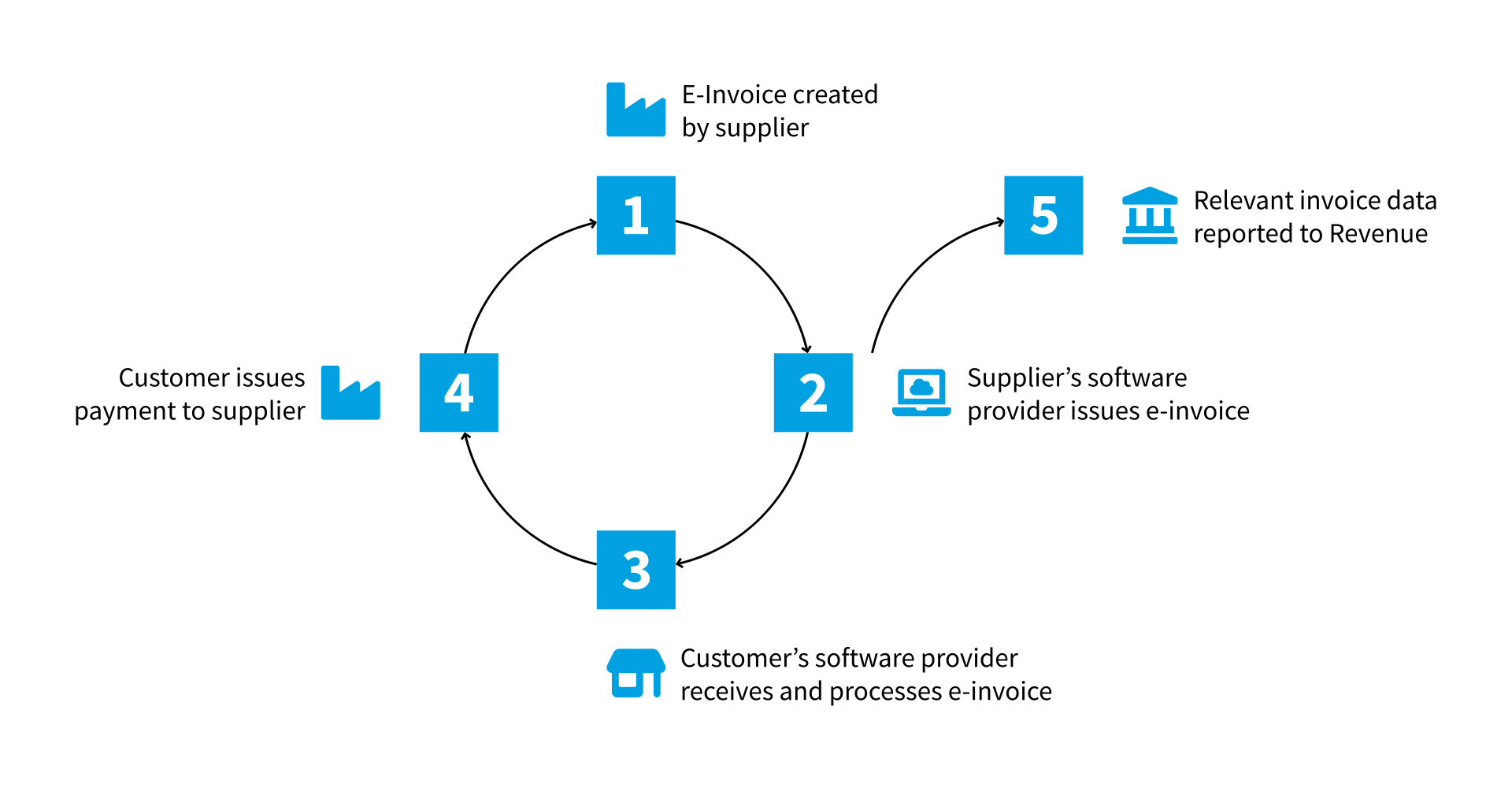
Connectivity
For companies, the practical impact is significant. They need to think beyond invoice creation and delivery. The architecture affects how invoice data is formatted, validated, routed, monitored, and connected back into ERP, accounts receivable, accounts payable, payment, and archiving processes, while it also raises questions around interoperability. This is where common standards, network connectivity, and potentially Peppol-based interoperability become important planning topics.
Invoice lifecycle information
Spain’s legal framework already points to invoice status information as part of the mandate. The final technical rules still need to define how this information will be exchanged, which statuses will be required, and how platforms and systems will handle them. Companies should therefore prepare for invoice status handling as a compliance-relevant process, not only as an internal visibility benefit.
Beyond compliance: automation and process optimization
Spain’s B2B e-invoicing mandate starts as a compliance requirement, but its real business impact goes further. Because the mandate is expected to combine structured invoice data, platform-based exchange, and invoice lifecycle status tracking, companies will need to look at the full process behind the invoice, not only the invoice file itself. This matters because many invoice processes are already digital on the surface but still manual underneath.
| Pain point | Resulting inefficiency | Key concern |
| Fragmented invoice channels | Invoices move through ERP systems, billing tools, email, portals, and partner-specific processes without a consistent end-to-end flow. | Teams lack transparency and spend time reconciling what happened where. |
| Manual checks and corrections | Finance teams need to review, enrich, or correct invoice data before processing can continue. | Errors can delay validation, approval, posting, payment, and status updates. |
| Poor master data quality | Incorrect tax identifiers, customer data, supplier data, or invoice references can create downstream issues. | Structured invoice exchange makes data quality problems visible earlier and more consistently. |
| Country-specific workarounds | Each mandate is handled with separate tools, mappings, and manual process logic. | Complexity grows with every new European e-invoicing requirement. |
Structured e-invoicing addresses these issues at the root by making invoice data consistent, machine-readable, and easier to validate. However, structured data only creates real business value when companies can use it throughout the invoice process. Invoice data needs to flow reliably into ERP systems, accounts payable and accounts receivable processes, approval workflows, payment processes, monitoring tools, and archives. Otherwise, teams may receive structured invoices but still need to move, check, or correct information manually.
The business case for Spain therefore does not end with mandate compliance. It emerges when companies use the regulatory trigger to create more automated, transparent, and integrated invoice processes across Finance and IT. Used strategically, preparation for Spain can support broader business improvements:
- Cleaner invoice and master data
Structured exchange makes missing, inconsistent, or incorrect data easier to detect before it disrupts downstream processes. - Fewer manual steps
Automated validation, routing, and exception handling reduce repetitive work in accounts payable and accounts receivable. - Faster invoice processing
Better data and integrated workflows can shorten the path from invoice creation or receipt to approval, posting, and payment. - More reliable lifecycle visibility
Status information becomes more transparent and useful when it is connected to the systems where acceptance, rejection, payment, and exceptions are managed. - Scalable readiness beyond Spain
The same capabilities needed for Spain, structured data, platform connectivity, validation, monitoring, and ERP integration, can also support other European e-invoicing and reporting mandates.
What Spain’s mandate means for Finance, IT, and the wider business
Spain’s B2B e-invoicing mandate will not sit neatly in one department. The mandate should therefore be treated as a shared transformation topic. Compliance may be the trigger, but successful implementation depends on how well Finance, IT, Tax, Compliance, ERP teams, and local business units align around data, integration, process ownership, and scalability.
Track invoice statuses as part of mandate readiness
Finance teams will be directly affected because Spain’s mandate is expected to require companies to provide invoice status information, although the final technical implementation still needs to be confirmed. This means status handling should not be treated only as an internal reporting benefit. Companies need to prepare for invoice statuses to be captured reliably, connected to the right business processes, and made available through the required channels once the final rules are published.
This affects how teams manage accepted, rejected, paid, or outstanding invoices across accounts receivable and accounts payable. Structured invoice data can reduce manual entry and correction work, but only if it is reliable and integrated into daily finance operations.
- Cleaner invoice and master data for validation, posting, and payment
- Earlier detection of missing, incorrect, or inconsistent invoice information
- Reliable capture and handling of invoice statuses, such as accepted, rejected, paid, or outstanding
- Fewer manual checks and corrections in accounts payable and accounts receivable
- More transparent exception handling across suppliers, customers, and internal teams
- Stronger connection between invoicing, cash collection, and payment behavior
Connect platforms, systems, and invoice data reliably
Spain’s mandate is an integration challenge. Companies will need to connect ERP systems, billing tools, AP and AR processes, private platforms, and potentially the public e-invoicing platform without creating another isolated compliance layer.
- Support for structured invoice formats and possible format conversion
- Integration with private platforms, public platform requirements, and partner channels
- Reliable validation rules and error handling across systems
- Secure and traceable data flows between platforms, ERP, finance, archiving, and monitoring
- Ability to process invoice status information and return it to the right systems
- Architecture choices that can scale beyond Spain and support further European mandates
Build a scalable foundation beyond Spain
The biggest impact will appear where Finance and IT responsibilities overlap. Spain’s mandate will require companies to translate regulatory requirements into practical process and system decisions. That includes who owns invoice data, who handles exceptions, which systems are authoritative, and how status information is captured and used.
- Clear ownership for invoice data, validation, platform connectivity, and status handling
- Better alignment between tax requirements, finance processes, and technical implementation
- Reduced risk of fragmented local tools or manual workarounds
- More consistent invoice processes across entities, countries, and ERP landscapes
- Stronger basis for process automation in order-to-cash and procure-to-pay
- Scalable e-invoicing readiness that can support Spain as well as future European requirements
How SEEBURGER can support mandate readiness in Spain
Spain’s B2B e-invoicing mandate will require more than the ability to create and send a structured invoice. Companies need to prepare for platform-based exchange, invoice status handling, ERP integration, validation, monitoring, and scalable processes that can also support further European mandates.
SEEBURGER helps companies turn these requirements into an integrated e-invoicing process. With the SEEBURGER E-Invoicing Hub and the BIS Platform, businesses can connect internal systems, external platforms, networks, and partners through one central integration layer instead of building another isolated country solution.
With SEEBURGER, Spain mandate readiness becomes more than a local compliance project. It becomes a way to connect structured invoice data with the platforms, ERP systems, and finance processes that companies already rely on, reducing manual work while building a scalable foundation for further European e-invoicing requirements.
Discover more about the SEEBURGER E-Invoicing Hub


