

From Peppol Connectivity to End-to-End Processes
Turn Peppol into an integrated business process to automate document flows, gain end-to-end visibility, and scale digital exchange across countries and use cases.
As B2B and B2G e-invoicing mandates expand, Peppol is becoming increasingly relevant for organizations around the world. But connecting to the network in a standards-compliant way is only part of the equation. The real challenge is embedding Peppol reliably into existing systems and business processes.
As a certified Peppol Access Point, SEEBURGER provides direct access to the international Peppol network and enables the standardized exchange of structured business documents with registered participants.
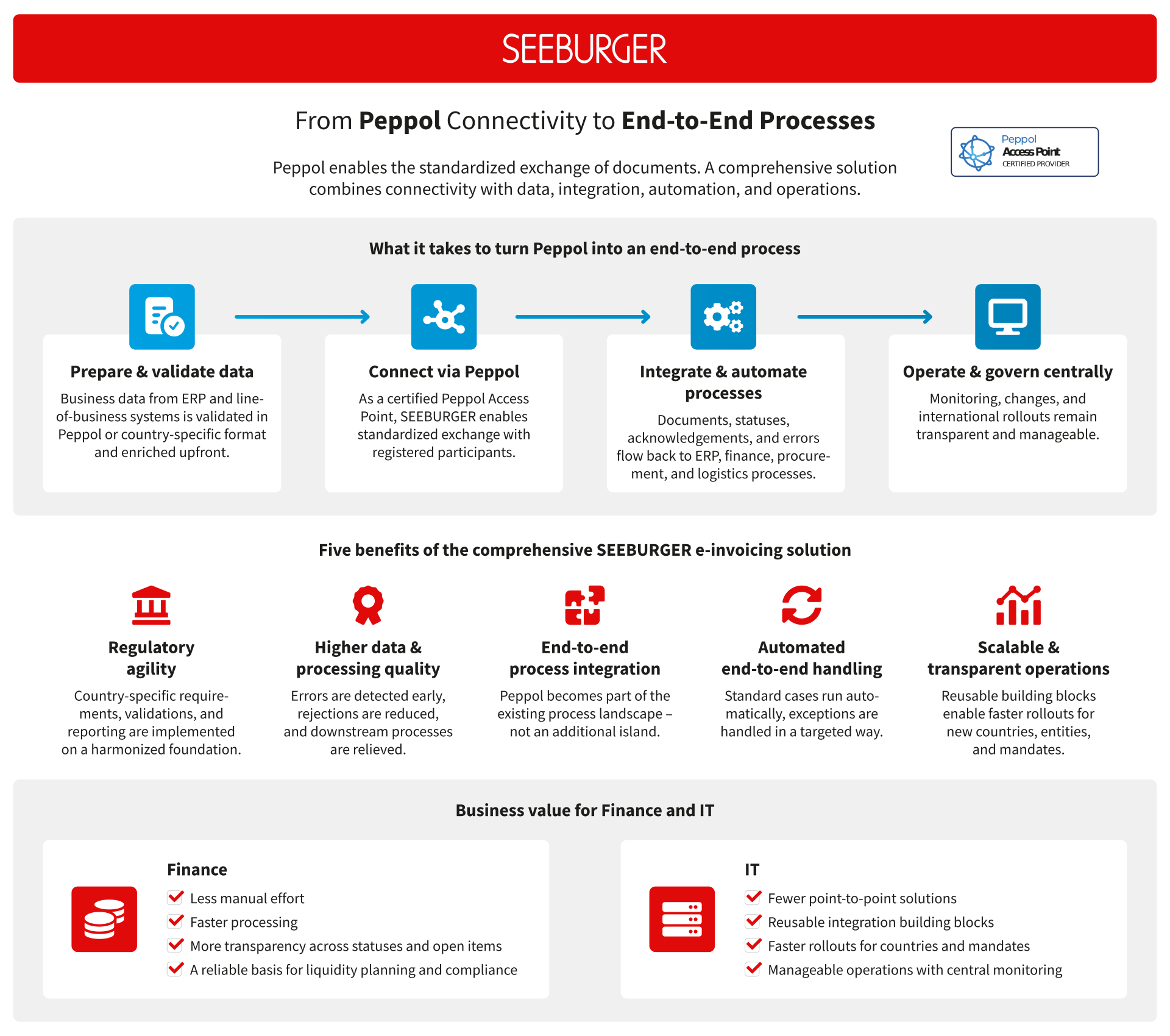
The real value, however, lies beyond connectivity. By combining Peppol with data preparation, country-specific compliance, backend integration, status handling, automation, and operations, network access becomes part of a seamless end-to-end business process rather than a standalone technical connection.
Peppol provides the standardized connection. SEEBURGER’s integrated E-Invoicing solution turns it into an automated, transparent, and globally scalable end-to-end process that reduces effort and improves visibility.
This Solution Brief is designed for professionals responsible for e-invoicing and finance, B2B/EDI and integration, IT architecture, and digital business processes who want to do more than simply connect to Peppol. Their goal is to make Peppol a sustainable part of the existing process landscape.
It shows how a certified Peppol Access Point can be combined with country-specific compliance, data preparation, backend integration, status handling, and automation to create an end-to-end e-invoicing process. The focus is on meeting regulatory requirements without introducing new process silos, additional manual work, or a succession of one-off projects for every new country and mandate.
Your shortcut to Peppol success:
Clear, concise insights at your fingertips, whenever you need them.
Peppol simplifies connectivity, but the process still needs to work
As B2B e-invoicing mandates expand, connecting to the Peppol network is becoming a regulatory requirement for organizations. Under the “Connect once, connect to all” principle, structured business documents can be exchanged with registered participants through a certified Access Point.
But this only solves the compliance and transmission layer. A functioning business process also depends on valid documents, country-specific requirements, reliable integration with existing systems, and seamless downstream processing. Status messages, errors, and regulatory changes must also remain manageable over time.
Turning Peppol access into an automated and sustainable business process requires connectivity, compliance, data, integration, process automation, and operations to work together.
This leaves five key challenges beyond network access alone.
Peppol changes the economics of partner onboarding
Peppol removes one of the biggest sources of complexity in traditional electronic business exchange, which means setting up and maintaining individual technical connections with every trading partner. What remains are the challenges around data quality, backend integration, and day-to-day operations. Comparing Peppol with traditional B2B/EDI makes it clear where Peppol reduces complexity and which requirements still need to be addressed beyond the network itself.
| Challenge | Traditional B2B/EDI | Peppol | What still needs to be addressed |
| International requirements | Standards, formats, and partner requirements are often agreed and implemented on an individual basis. | Common Peppol specifications provide a standardized foundation. | National mandatory fields, validation rules, and reporting processes still need to be implemented reliably and kept up to date as regulations evolve. |
| Data quality | Individual mappings reconcile different data models and trading partner requirements. | Standardized document structures reduce the need for bilateral format agreements. | Master, tax, and transaction data must be complete and validated for both business and technical accuracy before transmission. |
| Backend integration | Each partner connection may require its own interfaces, formats, and process logic. | A central network connection replaces numerous individual communication links. | Documents and responses still need to flow reliably between Peppol and ERP, finance, procurement, and logistics systems. |
| End-to-end processing | Deep, individually tailored process integration supports complex and industry-specific workflows. | Peppol standardizes transmission and core document processes. | Structured documents still need to move beyond delivery into validation, approval, posting, and downstream processes. |
| Operations and change | Partner changes, format adjustments, and testing are often managed connection by connection. | Common network rules reduce individual changes at the transport layer. | Monitoring, error analysis, status handling, specification updates, and changing country requirements still need to be coordinated as part of ongoing operations. |
From Peppol access to a fully integrated business process
As a certified Peppol Access Point, SEEBURGER provides direct access to the international Peppol network and the foundation for standards-based exchange of structured business documents with registered participants.
The integrated SEEBURGER E-Invoicing solution goes beyond network connectivity by bringing together the capabilities needed for an end-to-end business process. Existing business data is transformed into compliant documents, exchanged via Peppol, and integrated directly into the relevant backend systems and business workflows.
The result is one continuous process built on four core capabilities that address the full e-invoicing lifecycle, not compliance alone.
1.
Turn business data into compliant documents
Master and transaction data originates in the ERP system or the relevant business application. From there, it is prepared, mapped to the required fields, and transformed into the appropriate Peppol or country-specific format.
The SEEBURGER E-Invoicing solution processes the existing data, converts it into the required target format, and highlights missing or incorrect information.
- Mappings align ERP or application data with the fields required by the relevant Peppol or country-specific format.
- Templates provide reusable format specifications.
- Validations check whether the resulting document meets technical and regulatory requirements.
Missing mandatory information and invalid data can therefore be identified early. This reduces manual format conversion and downstream error correction, while ownership of the underlying business data remains with the responsible source system.
2.
Reach more trading partners through a single connection
As a certified Access Point, SEEBURGER enables standards-compliant communication with registered participants across the Peppol network. In addition to traditional 4-corner scenarios, the architecture can also support extended models in which tax-relevant data is transmitted to the responsible authority.
Where national regulations require it, reporting and government-facing processes can be incorporated alongside document exchange. This allows e-invoicing and e-reporting to operate within one coordinated architecture instead of relying on separate channels.
3.
Embed Peppol into existing business processes
Incoming and outgoing business documents are connected directly to ERP, finance, procurement, and logistics systems. This allows documents to move from source systems into Peppol and incoming documents to flow back into the appropriate backend processes.
Status messages, confirmations, rejections, and errors can also be returned to the relevant systems. Instead of remaining visible only in Access Point monitoring, they become available where business teams and IT need them for further processing.
This integrated setup also creates the foundation for automation beyond basic compliance and connectivity. Successfully sent or received documents can be routed automatically, status updates can be processed without manual intervention, and downstream steps can be triggered in the relevant business workflow. Exceptions and errors can be directed to the right teams for resolution.
The result is an integrated process landscape where:
- Documents move seamlessly between Peppol and backend systems.
- Status updates and errors are visible where they need to be handled.
- Recurring process steps can run automatically.
- Business teams are not dependent on separate Access Point monitoring.
- Peppol becomes part of the existing process landscape rather than another standalone silo.
The process therefore continues well beyond successful transmission and extends into day-to-day operational workflows.
4.
Centralize operations and scale across markets
Monitoring, error handling, and specification updates are managed on a shared foundation. Existing formats, mappings, interfaces, and process components can be reused across additional countries, legal entities, and use cases.
New rollouts can therefore build on an established integration framework instead of treating every mandate as a standalone project. This reduces implementation effort, shortens rollout times for new mandates, and creates a more consistent operating model across markets.
The benefit goes beyond technical scalability: organizations can expand into new requirements faster while maintaining greater control and reducing operational complexity.
Beyond the Access Point: where process expertise creates real value
Peppol provides standardized connections between businesses, but the real business value starts when that connection becomes part of a working end-to-end process.
An integrated e-invoicing approach combines document exchange with data preparation, validation, backend integration, status handling, automation, and international scalability. This prevents Peppol from becoming a standalone communication channel and embeds it into the existing process landscape.
That is the key difference between basic Access Point connectivity and a fully integrated Peppol solution. Peppol enables the exchange, while SEEBURGER extends it into seamless, automated business processes that can scale across countries.
The integrated SEEBURGER E-Invoicing solution combines Peppol connectivity with country-specific format generation, validation, and compliance services. National requirements can be incorporated into a coordinated e-invoicing architecture and adjusted as regulations evolve.
This allows new B2B e-invoicing mandates to build on an existing foundation instead of requiring separate format, validation, and reporting processes for each country. The result is less adaptation effort and a more efficient transition of regulatory changes into day-to-day operations.
Outgoing documents are passed from source systems into Peppol, while incoming documents, confirmations, status messages, and rejections are routed back into the appropriate backend systems and business workflows.
This avoids process breaks and duplicate data entry. Rather than becoming another technical silo, Peppol is embedded into the existing process landscape, with relevant information available where operational activities are managed and business decisions are made.
A shared integration foundation brings these activities together centrally. Established formats, mappings, interfaces, and process components can be reused across additional countries, legal entities, and use cases.
This means new rollouts do not have to start from scratch. Central visibility into status and errors simplifies day-to-day operations, while reusable integration components reduce the effort required to support additional mandates, business units, and countries.
Mappings and templates transform existing ERP and application data into the required Peppol or country-specific format, while validation identifies missing mandatory information and non-compliant data early in the process.
This helps surface data issues before transmission rather than only after a recipient rejects the document. The result is fewer correction cycles, less manual rework, and fewer delays in downstream posting and payment processes. Responsibility for correcting the source data itself remains with the relevant system of record.
An integrated e-invoicing solution connects documents, status messages, confirmations, rejections, and errors with the relevant business processes. Recurring steps can be triggered automatically, while exceptions are routed to the right teams for resolution.
The process therefore continues beyond successful delivery. Routine transactions can move forward without constant manual intervention, specialists can focus on exceptions, and processing times are reduced.
One integrated foundation, distinct business value for Finance and IT
An integrated e-invoicing solution delivers more than regulatory compliance and technical connectivity. By bringing together data quality, backend integration, automated processing, and centralized operations, it creates tangible value for the teams that rely on these processes every day. Finance and IT benefit in different ways, while working from the same integrated process foundation.
Less rework, faster processing, greater control
For finance teams, the real value emerges when Peppol is embedded into the broader financial process rather than treated as a standalone transmission channel. Combining compliant document creation, early validation, backend integration, and automated downstream processing reduces correction loops and manual intervention.
Because status updates, rejections, and errors are fed back into the relevant finance processes, they do not remain isolated in Access Point monitoring. Routine cases can continue automatically, while specialists focus on exceptions and decisions that require business judgment.
A regulatory obligation can therefore become a more efficient finance process that reduces operational effort while improving control. The benefits include:
- Less manual rework through early checks and valid documents
- Shorter processing times through automated downstream handling
- Greater visibility into status, errors, and open items
- Fewer delays in posting and payment
- A more reliable basis for liquidity planning, financial close, and compliance
Fewer point solutions, faster rollouts, manageable operations
For IT teams, the key advantage is avoiding yet another standalone system for Peppol. Instead, network connectivity is embedded into the existing integration and process landscape and connected with ERP, finance, procurement, and logistics systems.
Formats, mappings, interfaces, and process components can be reused across new countries, legal entities, and mandates. This allows future rollouts to build on an established foundation rather than requiring new point-to-point integrations and separate operating models each time.
By extending beyond network access and compliance, an integrated approach creates a resilient architecture that can absorb regulatory change without adding more fragmented solutions to the IT landscape. In practice, IT benefits from:
- Fewer standalone solutions and lower integration complexity
- One common foundation for Peppol, e-invoicing, and additional country requirements
- Reusable mappings, interfaces, and process components
- Transparent monitoring and clear error handling
- Less effort for operations, change management, and international rollouts.
B2B e-invoicing is accelerating Peppol adoption
How countries’mandates are putting Peppol to work
Regulatory mandates and government-led digitalization initiatives are now major drivers of Peppol adoption, but national models vary considerably. In some markets, Peppol already serves as the primary channel for domestic B2B e-invoicing. Others are still preparing their rollout or are combining Peppol with additional digital reporting requirements.
 Belgium
B2B mandate in effect since January 2026
Since January 1, 2026, businesses established in Belgium and subject to VAT are generally required to send and receive structured electronic invoices. Peppol BIS Billing over the Peppol network is the standard route, while alternative EN 16931-compliant methods are only permitted by mutual agreement.
Belgium demonstrates how an established Peppol infrastructure can be used directly as the foundation for a nationwide B2B e-invoicing mandate.
 France
Peppol as the interoperability layer for France’s e-invoicing reform
France is introducing its B2B e-invoicing and e-reporting obligations in phases from September 1, 2026. Businesses must use a government-approved Plateforme Agréée (PA), which exchanges invoices with their trading partners’ platforms and submits the required data to the tax authority.
The French tax administration has acted as a Peppol Authority since July 2025. Within the French platform model, Peppol supports interoperability between platforms and accommodates not only Peppol BIS Billing, but also the formats and status messages required in France.
France illustrates how Peppol can serve as a standardized interoperability layer even within a decentralized e-invoicing and e-reporting model.
 Norway
Issuing becomes mandatory in 2027, receiving in 2030
Norway is phasing in its requirements over several years. From January 1, 2027, businesses subject to bookkeeping obligations must issue electronic invoices. Mandatory digital bookkeeping and automated receipt of electronic invoices will follow from January 1, 2030. Further details on formats and exemptions are still being defined through supplementary regulations.
Norway shows how a widely established Peppol infrastructure can gradually evolve into the backbone of a broader B2B e-invoicing mandate.
 United Kingdom
B2B e-invoicing mandate announced for 2029
The United Kingdom plans to make electronic invoicing mandatory for VAT-registered B2B and B2G transactions from 2029. The government has identified Peppol as the core interoperability infrastructure, while the final operating model and further technical details are still being developed.
The UK decision shows how Peppol can evolve from an established infrastructure used in parts of public procurement into a nationwide foundation for B2B invoice exchange.
 Slovakia
Peppol-based e-invoicing and reporting model planned
Slovakia plans to introduce mandatory electronic invoicing for selected domestic B2B transactions from 2027, together with real-time digital reporting to the tax authority. Businesses are expected to be able to use a Peppol-based delivery service with Peppol BIS 3. The model therefore combines invoice exchange with tax reporting. Final details remain subject to the outcome of the legislative and implementation process.
Slovakia represents the next stage in Peppol adoption: the network is used not only for business-to-business document exchange, but can also support additional reporting flows.
 Malaysia
Peppol bridges process digitalization and tax compliance
Malaysia uses Peppol as part of its national e-invoicing initiative, with two closely linked objectives: digitalizing and automating invoice exchange between businesses, and meeting tax reporting requirements.
Peppol-based B2B exchange is currently voluntary. At the same time, a Peppol Service Provider can be used as a transmission channel for tax-relevant e-invoicing data. Malaysia has also introduced MY PINT, a local specification that aligns Malaysian business and tax requirements with the international Peppol framework.
In Malaysia, Peppol therefore supports more than regulatory compliance. It also provides a foundation for interoperable, automated B2B processes.
 Japan
Japan
Peppol as a foundation for digital business processes
Japan is advancing digital invoicing through a government-coordinated Peppol initiative. The Digital Agency serves as the national Peppol Authority and manages JP PINT, a Peppol-based specification tailored to invoice exchange in Japan.
In addition to standard invoices, Japan also supports self-billing invoices and invoices issued by businesses that are not tax-registered. The focus is not on a nationwide B2B mandate, but on standardizing and automating digital invoice exchange between businesses and with public-sector organizations.
In Japan, Peppol therefore serves as a nationally coordinated foundation for interoperable business processes even without a general legal mandate.
 Australia &
  New Zealand
A shared Peppol approach for trans-Tasman trade
Australia and New Zealand have pursued a coordinated approach to e-invoicing based on the Peppol framework since 2019. Both countries have their own Peppol Authorities, but work closely together and use PINT A-NZ as a shared regional specification.
E-invoicing is not generally mandatory for businesses across either market, but the public sector is actively driving adoption. In New Zealand, certain government agencies have been required to send and receive electronic invoices since January 2026. From January 2027, those agencies will also be required to request e-invoices from large suppliers. Australia is likewise promoting Peppol as a national standard and has introduced corresponding requirements for selected government entities.
Australia and New Zealand show how common standards and public-sector demand can drive Peppol adoption progressively across national borders.
Connect to Peppol with confidence and integrate it seamlessly into your e-invoicing processes. Discover how the SEEBURGER Peppol Access Point combines standardized connectivity with automation, compliance, and backend integration.


Learn how the SEEBURGER E-Invoicing Hub helps you ensure compliance and automate your invoicing processes efficiently. Country-specific requirements, Peppol connectivity and seamless integration with SAP are at the core.

See how compliant e-invoicing data becomes controlled AP workflows with automated routing, guided exceptions, and operational visibility.

Get ready for the UK’s 2029 shift to structured e-invoicing. See what’s confirmed, what’s still open, and how Finance and IT can align early to reduce risk and enable automation.