
France:
Mandatory B2B E-Invoicing and E-Reporting
France introduced mandatory B2B e-invoicing and e-reporting on September 1, 2026. Since then, all affected companies established or VAT-registered in France must be able to receive electronic invoices. Large enterprises and mid-sized companies, known as ETIs, must also issue e-invoices and submit the required e-reporting data. The issuance and e-reporting obligations will apply to SMEs and microenterprises from September 1, 2027. The reform has introduced continuous transaction controls (CTC), including the transmission of invoice and selected payment data to the tax authority and the exchange of standardized invoice lifecycle statuses across platforms. These controls support France’s efforts to reduce its VAT gap.
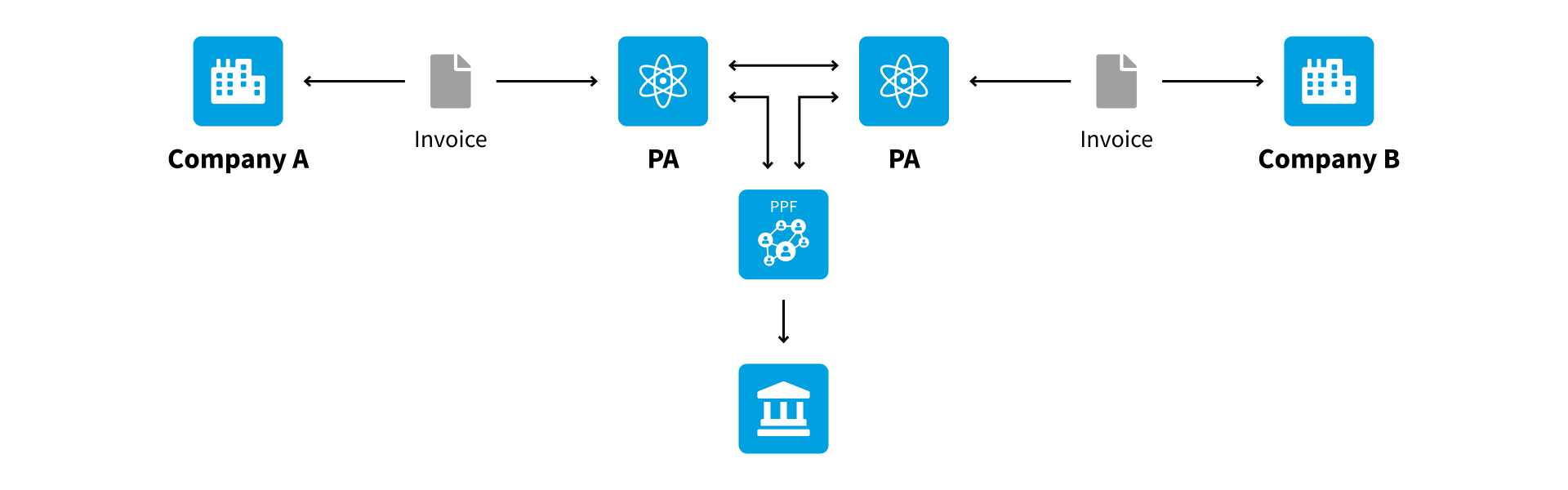
France’s Y-model underpins the architecture and combines government oversight with decentralized invoice exchange. The Public Invoicing Portal, or PPF, provides the national directory and consolidates data for the tax administration. B2G processes continue to run through Chorus Pro. B2B e-invoices are exchanged through approved private platforms known as Plateformes Agréées (PAs). These platforms send, receive, and convert electronic invoices, transmit the required data to the tax administration, and support the exchange of mandatory status information. Companies may use one or more PAs. Other syntaxes, including EDIFACT, remain available where a PA converts the invoice into an approved format for compliant delivery.
Scope is broad. Domestic B2B invoices must be electronic and status-tracked. All VAT-registered companies must e-report cross-border B2B and B2C transactions, and report payments received across B2B, B2C, and B2G. The national directory ensures correct routing by listing recipients’ e-invoicing addresses and their PA. Regulated B2B invoice exchange takes place through PAs. The PPF provides the national directory and consolidates the data required by the tax administration.
Successful compliance requires clear decisions on platform strategy, format handling, directory onboarding, integration, monitoring, and e-archiving – ideally with conversion ser vices to reconcile legacy EDI with the mandated standards.
France: Mandatory B2B E-Invoicing and E-Reporting from 2026
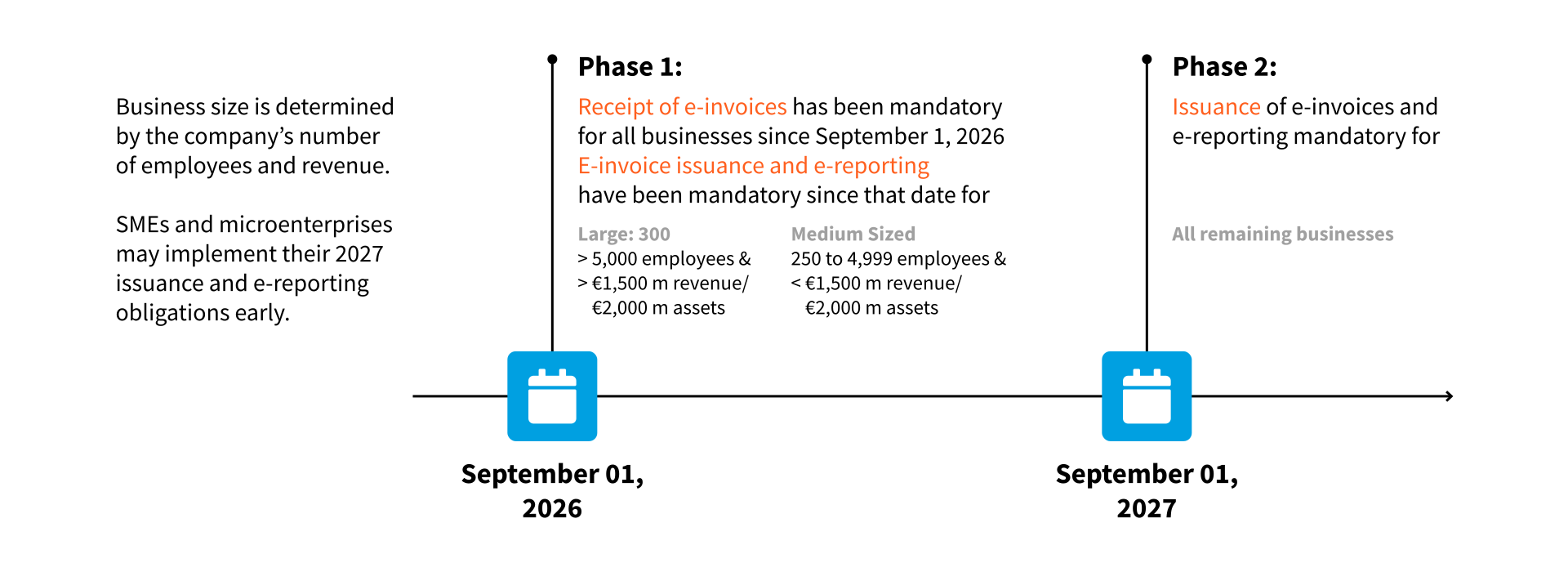
France introduced mandatory B2B e-invoicing and e-reporting on September 1, 2026. Since then, all affected companies must be able to receive electronic invoices. Large enterprises and mid-sized companies, known as ETIs, must also issue e-invoices and submit the required e-reporting data. The issuance and e-reporting obligations will apply to SMEs and microenterprises from September 1, 2027. The first rollout phase has therefore been in effect since September 2026, with the second phase following one year later.
The reform applies first to large enterprises and ETI, followed by SMEs and micro-enterprises. The reform has introduced the transmission of invoice and certain payment data to the tax authority, together with the use of invoice lifecycle statuses across the participating platforms. The French government expects these continuous transaction controls (CTC) to help combat fraud and tax evasion and reduce the country’s VAT gap. France’s VAT gap was estimated at approximately EUR 12.784 billion in 2022, equivalent to 6.0% of its total VAT liability.
Architecture overview: France’s Y-model, scope, and roles
The French mandate is based on a complex Y-model and applies to domestic and cross-border B2B, B2C and B2G transactions, including specified invoice and payment data defined in the decree. Both its Y-model architecture and its scope make it challenging.
The Y-model, complex yet resilient and flexible
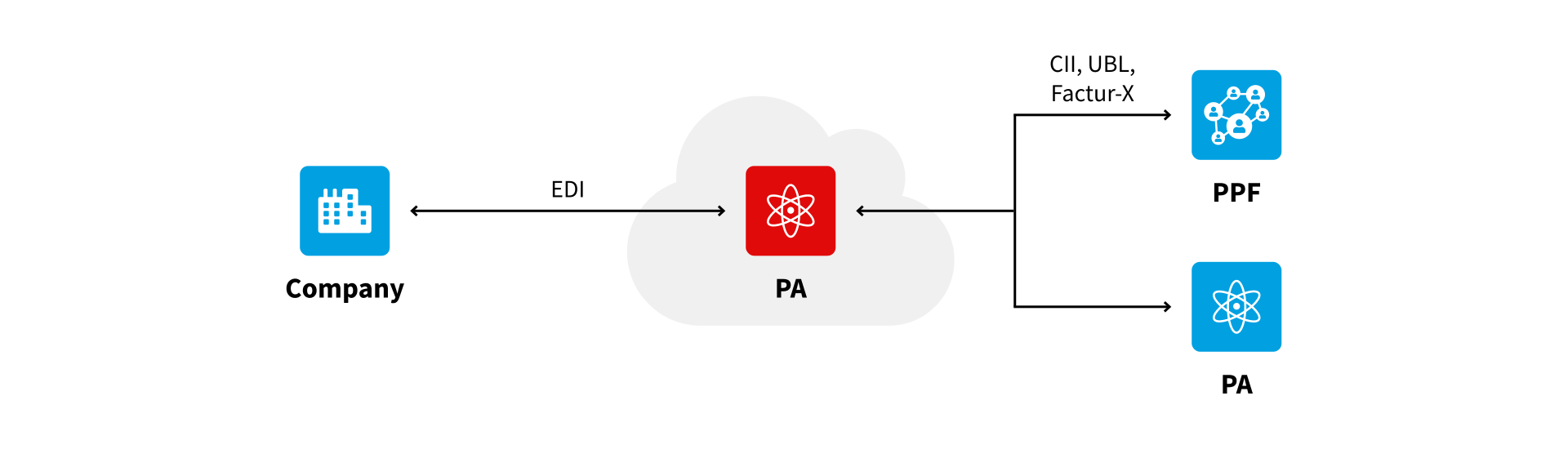
The French model of mandatory B2B e-invoicing and e-reporting offers considerable flexibility, particularly for companies with established EDI processes. Existing formats and integrations can be connected to the new infrastructure through a PA. Companies can work directly with a PA or use a compatible solution connected to one. In both cases, regulated B2B e-invoices are sent and received through an approved platform.
PPF
The Public Invoicing Portal, or PPF, performs central government functions within the French model. It provides the national directory and consolidates the invoice, transaction, and payment data required by the tax administration. The PPF does not offer companies a direct channel for sending or receiving B2B e-invoices. B2G invoices continue to be processed through Chorus Pro.
PA
A Plateforme Agréée (formerly PDP) is an immatriculated private platform. It can send, receive and transmit e-invoices in the mandated formats (Factur-X, UBL, CII), and forward required data to the administration. Regulated B2B invoice exchange requires a PA or a compatible solution connected to one.
Large scope encompassing e-invoicing and e-reporting
The following outlines the scope of the reform. Electronic invoicing for B2G transactions has already been mandatory through Chorus Pro since 2017 and is therefore not part of the newly introduced requirements.
The obligations that currently apply depend on company size and whether the company receives or issues electronic invoices.
Use of a PA is required for B2B exchange and PPF remains the public hub
Uncertainty remains about the respective roles of the PPF and PAs. For regulated B2B invoice exchange, companies connect to a PA directly or use a compatible solution connected to one. The PPF provides the national directory and consolidates the data required by the tax administration. B2G processes continue to run through Chorus Pro.
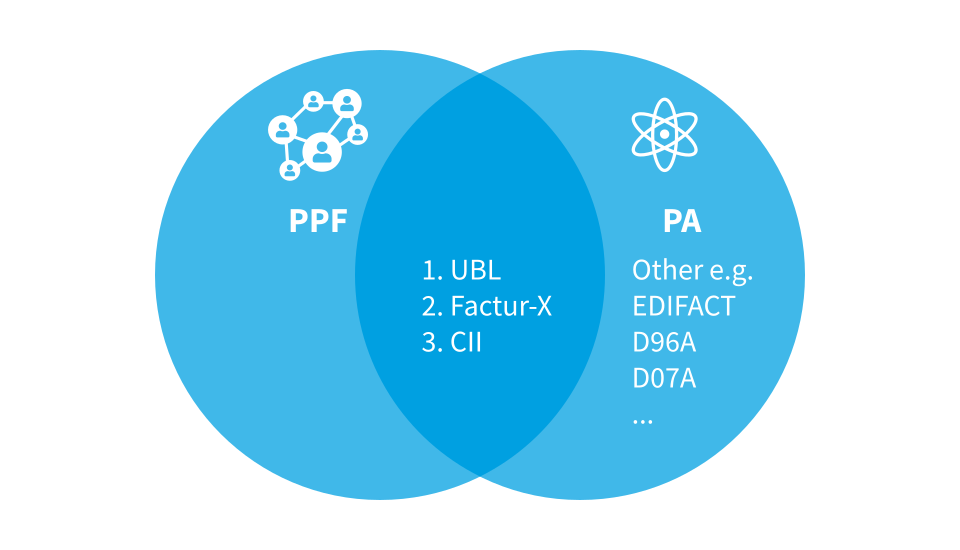
The PPF performs central directory and data functions within the French infrastructure, while B2B invoices are exchanged through PAs. France supports UBL, CII, and Factur-X for compliant delivery based on the European standard EN16931. Business partners may continue to agree on other syntaxes, including EDIFACT. In these cases, a PA converts the invoice into an approved format and routes it through the regulated infrastructure.
Invoice issuers are not required to use formats beyond UBL, CII, and Factur-X for compliant delivery. Business partners may nevertheless agree to exchange other syntaxes, such as EDIFACT. In these cases, a PA converts the invoice into an approved format and delivers it to the recipient’s registered PA. The term PDP is the former designation for what is now known as a PA.
Receipt of E-Invoices Mandatory Since September 1, 2026
Companies receiving domestic invoices through several existing channels must support the three approved formats through their chosen setup and designate a PA as their receiving route in the national directory. A compatible solution can provide API integration with the PA, onboarding, electronic archiving, monitoring, automated error notifications, and related services.
Companies receiving domestic e-invoices in EDIFACT or other syntaxes still designate a PA as their receiving route. The sender’s PA or compatible solution converts these invoices into an approved format and delivers them to the recipient’s registered PA in accordance with the national directory.
Companies that agree to exchange domestic invoices in a syntax such as EDIFACT require a PA for the regulated invoice flow. Approved private platforms must demonstrate compliance with the tax authority’s requirements as part of the registration process. Registration is granted for a renewable period of three years. The cost depends on the selected service model, invoice volume, and required functions. All regulated B2B invoices are routed through a PA.
Using the designated PA for B2B invoices provides a consistent approach across different source formats. Where suppliers use EDIFACT or another syntax, the PA or compatible solution converts the invoice into Factur-X, UBL, or CII before delivery. Costs depend on the selected provider, service model, and service level.
The National Directory lists each recipient’s e-invoicing address and the PA responsible for the associated routing information. Senders route invoices according to this entry. Companies may define multiple addresses for individual entities, while delivery continues through the PA registered for the respective recipient.
A compatible solution can support the cost-effective exchange of invoices through the designated PA. Where business partners agree to use other syntaxes, such as EDIFACT, the solution can process these formats and connect them to the PA service. Delivery under the mandate remains based on Factur-X, UBL, or CII.
Various standards for e-invoices
France supports UBL, CII, and Factur-X for compliant e-invoice delivery. Companies exchange regulated B2B e-invoices through a PA or a compatible solution connected to one.
Business partners may continue to agree on other syntaxes, including EDIFACT D96A or D07A. A PA can process these formats, convert the invoice into an approved format, and connect established EDI processes to the French infrastructure.
A compatible solution can support integration, data conversion, monitoring, and electronic archiving. Regulated invoice exchange and the transmission of mandatory data continue to take place through a PA.
How SEEBURGER Supports E-Invoicing in France
SEEBURGER provides cloud-based e-invoicing services for global and country-specific regulatory requirements. Multinational and French companies benefit from local expertise, established French e-invoicing services, DEMAT “EDI complete - B2B” conformity, and Factur-X services for B2B and B2G processes through Chorus Pro.
SEEBURGER received final registration as a Plateforme Agréée on January 16, 2026. This provides companies with an officially approved platform for meeting the French e-invoicing and e-reporting requirements. The final registration establishes a reliable foundation for productive invoice exchange and integration with existing finance and ERP processes.
The SEEBURGER E-Invoicing Hub supports invoice exchange, e-reporting, format conversion, routing, monitoring, and document status management within a connected SaaS environment. SEEBURGER Global E-Invoicing Services integrate with SAP Document and Reporting Compliance on SAP ECC and SAP S/4HANA as well as other ERP systems.
How can SEEBURGER E-Invoicing support your digital transformation?


Discover how to turn Peppol connectivity into integrated, automated, and scalable end-to-end e-invoicing processes.

See how compliant e-invoicing data becomes controlled AP workflows with automated routing, guided exceptions, and operational visibility.

Learn how the SEEBURGER E-Invoicing Hub helps you ensure compliance and automate your invoicing processes efficiently. Country-specific requirements, Peppol connectivity and seamless integration with SAP are at the core.