
Slovakia’s
B2B E-Invoicing Mandate Takes Effect in 2027
What businesses need to know about Peppol, e-reporting, and implementation readiness
Slovakia is introducing mandatory B2B and B2G e-invoicing in two phases. Its framework follows a decentralized Peppol 5-corner model, in which certified delivery service providers, commonly referred to as digital postmen, transmit e-invoices between suppliers and customers. At the same time, the required invoice data is reported to the Slovak Financial Administration. Because the authority does not approve invoices before delivery, the model does not operate as a clearance system.
Mandatory e-invoices must contain structured, machine-processable data that complies with EN 16931. Invoices exchanged through the standard Peppol process must also meet Peppol BIS Billing 3.0 and Slovakia’s national validation rules. A PDF alone does not qualify as an e-invoice. During the national transitional period, existing EDI connections may continue to be used under certain conditions, provided the invoice data is converted into an accepted structured format.
Implementation therefore extends well beyond the transmission channel. Businesses must also account for exemptions, corrections, consolidated invoices, archiving, and the processing of delivery, validation, and reporting statuses. This requires Finance, Tax, and IT to align invoice flows, data sources, responsibilities, systems, and error-handling processes.
January 1, 2027: The countdown to mandatory e-invoicing has begun
Slovakia is rolling out mandatory B2B and B2G e-invoicing in two major phases.
| Date | Milestone | What does this mean for businesses? |
| Since January 1, 2026 | The legal framework for certified delivery service providers has been in place. | Providers can apply for accreditation as digital postmen. Businesses can assess the available solutions and prepare their technical connectivity. |
| Since June 1, 2026 | Slovakia’s e-invoicing infrastructure has been available for voluntary use. | Businesses can test structured invoice exchange ahead of the mandatory start. This includes selecting a delivery service provider, connecting to Slovakia’s Peppol infrastructure, and testing ERP, accounting, and invoicing systems. |
| From January 1, 2027 | E-invoicing becomes mandatory for certain domestic B2B and B2G transactions. | VAT taxpayers established in Slovakia must issue affected invoices in a structured electronic format. Domestic businesses and other entities within scope must be able to receive these e-invoices. When invoices are transmitted through a certified delivery service provider, the required tax data is reported automatically to the Financial Administration. |
| January 1, 2027, to June 30, 2030 | The national transitional regime applies. | The obligations are already binding. “Transitional regime” does not mean a grace period; it describes the period before the harmonized ViDA rules take effect. During this phase, domestic invoices are subject to requirements including a 15-day issuance deadline and specific rules for alternative transmission channels. |
| From July 1, 2030 | Slovakia’s system will align with the harmonized ViDA requirements. | Digital reporting will extend to relevant cross-border transactions. At the same time, the standard invoice issuance deadline will be reduced from 15 to ten days. The existing VAT control statement and recapitulative statement will be abolished. |
The mandate creates different obligations for different businesses
Whether a business must issue or receive e-invoices, or report invoice data, depends on where it is established, its VAT status, and the transaction involved. A Slovak VAT registration alone, for example, does not automatically trigger an obligation to issue e-invoices.
Who is affected from January 1, 2027?
Issue, receive, and report invoice data
VAT taxpayers established in Slovakia face the broadest set of obligations. For domestic B2B and B2G transactions within scope, they must issue structured e-invoices and be able to receive corresponding invoices from their suppliers.
When invoices are exchanged through a certified delivery service provider, the legally required invoice data is reported automatically to the Financial Administration. Reporting applies on both the supplier and recipient sides, although the respective deadlines differ.
- Outgoing invoices must be generated in the required structured format.
- Incoming invoices must be receivable through a certified delivery service provider.
- ERP, invoicing, and accounting systems must be connected to the infrastructure.
- Tax-relevant invoice data must be complete and accurate.
- Corrections, credit notes, advance payments, and consolidated invoices must be covered by the process.
- Status messages and transmission errors must be processed in a traceable manner.
Receive e-invoices without a mandatory issuance obligation
Domestic businesses, self-employed individuals, and other taxable persons without a VAT registration are also within scope. Although they are not required to issue e-invoices, they must be able to receive them from VAT-registered suppliers.
This obligation can arise through routine business expenses, including invoices for telecommunications, energy, rent, goods, or business services.
- They need a certified delivery service provider, accessed either directly or through appropriately connected software.
- They must be reachable through Slovakia’s Peppol infrastructure.
- Access for internal or external accounting teams must be organized.
- Incoming XML invoices must be capable of being displayed and processed.
Receipt requirements extend beyond conventional businesses
The obligation to receive e-invoices also applies to domestic legal entities that do not operate as taxable businesses. This may include government bodies, municipalities, public institutions, associations, foundations, and nonprofit organizations.
If one of these organizations carries out taxable transactions and is registered for VAT, it may also become subject to the issuance requirement.
- They must be able to receive mandatory e-invoices from their suppliers.
- Procurement, accounting, and invoice review processes must be prepared for structured incoming data.
- A certified delivery service provider must be selected and contractually integrated.
- Responsibilities across the organization, accounting teams, and external service providers must be clearly defined.
- Organizations providing their own goods or services must determine whether they are also subject to an issuance obligation.
A Slovak VAT registration alone does not trigger the mandate
Between January 1, 2027, and June 30, 2030, businesses not established in Slovakia are generally not required to issue e-invoices solely because they hold a Slovak VAT identification number. Under the national transitional regime, the issuance obligation before July 2030 may apply only to persons established in Slovakia.
The published rules distinguish between establishment in Slovakia and VAT registration alone. The treatment of a fixed establishment may depend on the circumstances of the individual transaction.
- Slovak VAT registration and establishment must be assessed separately.
- Each Slovak entity and fixed establishment must be considered individually.
- Cross-border invoice flows are generally not yet covered by the 2027 national mandate.
- Domestic transactions involving a Slovak entity may, however, fall fully within scope.
- Relevant cross-border e-invoicing and reporting obligations must be considered for July 1, 2030.
Which transactions trigger the requirements?
A business’s status alone does not determine whether the mandate applies. The invoice must also relate to a domestic transaction within scope.
| Transaction | Treatment from January 1, 2027 |
| Domestic B2B transaction | Generally within scope when a VAT taxpayer established in Slovakia supplies goods or services to a domestic taxable person. |
| Domestic B2G transaction | Generally within scope when a domestic VAT taxpayer supplies goods or services to a Slovak legal entity or public sector organization. |
| B2C transaction | Not covered by the mandate. |
| Cross-border transaction | Generally not yet covered by the 2027 national mandate. The extension is scheduled for July 1, 2030. |
| Advance payment | Within scope when it relates to a transaction for which an e-invoice must be issued. |
Not every domestic invoice falls under the mandate
Not every domestic B2B or B2G invoice issued by a VAT-registered supplier must be created as an e-invoice. Exemptions apply in particular to certain VAT-exempt transactions, simplified invoices, and transactions subject to specific confidentiality requirements.
| Exemption | Treatment from January 1, 2027 | Business impact |
| VAT-exempt supplies of goods and services | There is generally no obligation to issue an e-invoice for the VAT-exempt transactions specified in Sections 28 through 43 and Section 47 of the law. | Businesses must distinguish accurately between taxable and VAT-exempt invoice flows. |
| Simplified invoices up to €100 | An eligible simplified invoice for goods or services with a total value of no more than €100 is exempt from mandatory e-invoicing. | Low-value receipts can continue to be processed outside the standard e-invoicing process. |
| Certain eKasa receipts | Legally recognized simplified receipts generated through the eKasa system are exempt within the applicable value limits. | If the relevant threshold is exceeded, a structured e-invoice may be required for an otherwise covered domestic B2B or B2G transaction. |
| Specific confidentiality and security cases | Specific confidentiality and security cases Special exemptions apply to certain invoices issued to Slovakia’s intelligence services and to transactions involving classified information. | These invoice flows must be handled separately from the standard e-invoicing process. |
Peppol connects decentralized invoice exchange with automated tax reporting
Slovakia is not introducing a central government invoice portal. Instead, its framework follows a Peppol-based 5-corner model. Certified delivery service providers exchange e-invoices directly between the systems of suppliers and customers, while the legally required invoice data is reported to the Financial Administration in parallel.
Peppol provides the network and the shared rules for document transmission. Access is delivered by providers that meet OpenPeppol requirements and are accredited by the Slovak Financial Administration. Businesses can work with these “digital postmen” directly or access their services through a connected ERP, accounting, or invoicing solution.
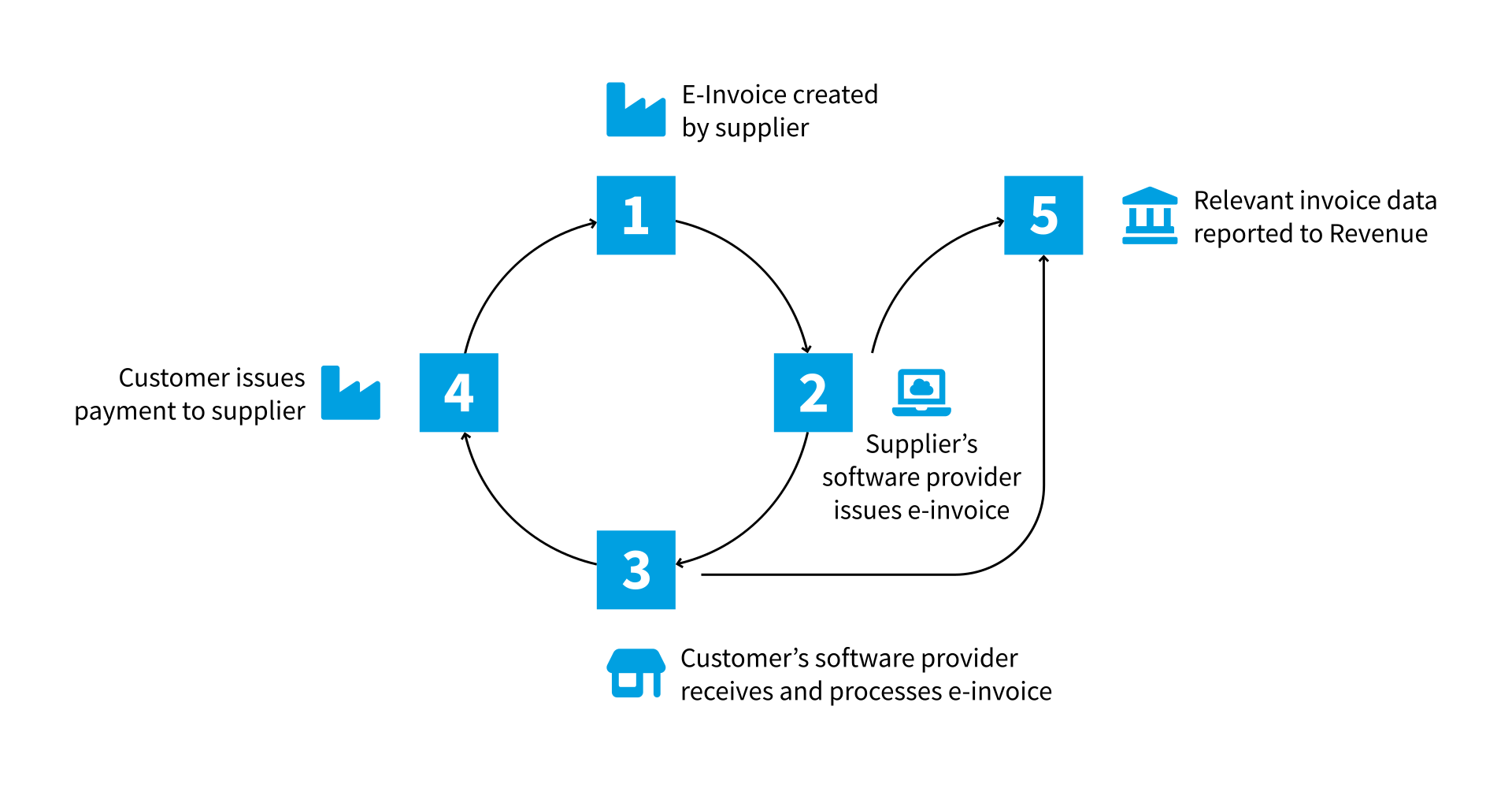
Complete master, tax, and invoice data is essential for successful validation, delivery, and reporting. When selecting a delivery service provider, businesses should consider not only Slovak accreditation, but also ERP connectivity, service levels, monitoring, error handling, and archiving capabilities.
Structured XML is mandatory, but Peppol is not the only option
Slovakia’s standard approach to e-invoice exchange uses Peppol and certified delivery service providers. During the national transitional regime, however, existing EDI connections and other transmission channels may continue to be used under certain conditions.
| Format | Status under the mandate | What businesses need to know |
| Peppol BIS Billing 3.0 | The designated standard for invoice exchange through the Peppol network. | It is based on UBL 2.1 and must also comply with Slovakia’s national validation rules. |
| UBL 2.1 | Generally accepted as an EN16931-compliant XML syntax. | Invoices transmitted through Peppol must follow Peppol BIS Billing 3.0 and the applicable Slovak requirements. |
| UN/CEFACT CII D16B | Generally accepted as an EN16931-compliant XML syntax. | When transmitted outside Peppol, a CII invoice must still meet the applicable legal and technical requirements. |
| EDIFACT and other existing EDI formats | Do not meet the legal definition without the necessary conversion. | The invoice data must be converted into an EN16931-compliant UBL or CII structure. |
Alternative channels remain available for now
From January 1, 2027, through June 30, 2030, trading partners may exchange e-invoices outside the certified delivery service infrastructure, provided the recipient agrees to the alternative channel.
Regardless of how it is transmitted, the invoice must be structured, machine-processable, and compliant with EN 16931. It must also contain all required invoice data, while authenticity of origin, integrity of content, and legibility must be maintained.
Businesses must nevertheless remain reachable through a certified delivery service provider.
Existing EDI processes can remain in place
During the national transitional regime, businesses may continue using established EDI connections with the recipient’s consent. An EDIFACT message alone is not sufficient, however. The invoice data must be converted into an EN16931-compliant UBL 2.1 or CII D16B structure and validated accordingly.
The channel determines how invoice data is reported
During the national transitional regime through June 30, 2030, automated tax data reporting is tied to the use of a certified delivery service provider. When a mandatory e-invoice is transmitted through this infrastructure, the delivery service providers involved report the required data to the Financial Administration.
If the invoice is sent through another channel with the recipient’s consent, the Financial Administration’s published interpretation states that neither the supplier nor the recipient has a reporting obligation for that invoice during this period.
E-invoicing and e-reporting operate as one connected process
In the standard process, certified delivery service providers transmit the e-invoice to the recipient while defined invoice data is reported to the Financial Administration in parallel. The authority does not review or approve the invoice before delivery, so Slovakia’s model is not a clearance system.
E-Invoicing
The supplier sends the complete structured e-invoice to the recipient through certified delivery service providers and the Peppol network. In the standard Peppol process, the invoice must comply with Peppol BIS Billing 3.0 and Slovakia’s national validation rules.
E-Reporting
The delivery service providers generate a separate Slovak Tax Data Document, or SK TDD, from the invoice and submit the required data to the Financial Administration. Supplier-side reporting generally takes place when the invoice is issued. VAT-registered recipients report the relevant incoming invoice data within five days of receipt. The technical submission is handled automatically through the delivery infrastructure.
Corrections, consolidated invoices, and archiving remain part of the structured process
The mandate extends beyond standard individual invoices. Corrections, consolidated invoices, and invoice retention must also meet the new requirements, with specific deadlines and process rules applying to each.
Corrective invoices
A correction must clearly reference the original e-invoice and include the amended information. If the original invoice was sent through a certified delivery service provider, the correction must also be transmitted through that channel in a structured format. It must generally be issued within 15 days after the end of the month in which the reason for the correction arose.
Consolidated invoices
Multiple supplies of goods, services, or advance payments may still be combined in a consolidated invoice, but only for a maximum period of one calendar month. The structured consolidated invoice must be issued within 15 days after the end of that month. Long-term payment schedules for recurring rental or utility services cannot replace this invoice.
Archiving
VAT taxpayers must retain e-invoices for ten years from the end of the calendar year to which the invoice relates. The structured XML file must be preserved, as archiving the visual PDF representation alone is not sufficient.
Finance, Tax, and IT need a shared implementation plan
The mandate brings together tax determination, structured invoice processing, and technical transmission. Finance, Tax, and IT therefore need to agree on the authoritative systems and data sources, assign ownership of technical and business exceptions, and define how invoice and reporting statuses flow back into operational processes.
For Finance, the mandate changes both incoming and outgoing invoice processes. Structured invoices must be reviewed, approved, posted, corrected, and archived reliably in their original XML format. Adding a new inbound channel alone is not enough. Downstream processes must also be able to use the structured data without additional manual transfer.
Key priorities for Finance include:
- Mapping existing invoice flows and identifying where invoices are currently exchanged by email, through portals, as PDFs, or via EDI
- Establishing clear procedures for technical rejections, missing information, incorrect invoices, and corrections
- Defining who handles incoming status messages and how to manage invoices that were delivered successfully but cannot be accepted from a business perspective
- Testing whether incoming invoice data flows correctly into accounting, approval, matching, and archiving processes
- Where accounting is outsourced, clarifying how access to the delivery service provider and the transfer of invoices will be organized
Tax determines which entities, transactions, and invoice types fall within the mandate. This requires a clear distinction between establishment in Slovakia and VAT registration alone. International corporate structures must also identify which Slovak entities or fixed establishments are involved in each transaction.
Key priorities for Tax include:
- Identifying affected entities and domestic B2B and B2G invoice flows, while clearly flagging exempt transactions in the relevant systems
- Translating this classification into unambiguous tax codes and process rules across the systems involved, with particular attention to the data reported to the Financial Administration
- Working with Finance and IT to define the source of required data, how its quality will be verified, and how corrections will be processed with a clear audit trail
For IT, the mandate is primarily an integration challenge. ERP, accounting, invoicing, and accounts payable systems must connect to a certified delivery service provider. They must also support Peppol BIS Billing 3.0, Slovakia’s national validation rules, and the automated transmission of tax data.
Key priorities for IT include:
- Mapping the existing system landscape and every invoice channel within scope; established EDI connections may continue under certain conditions, but EDIFACT and other noncompliant formats must be converted into an EN16931-compliant UBL or CII structure
- Returning delivery, validation, and reporting statuses to the authoritative systems
- Ensuring end-to-end monitoring can show whether an invoice was validated, delivered, and reported successfully, or identify where an error occurred
SEEBURGER connects Slovakia’s mandate with integrated e-invoicing processes
As a certified Peppol Access Point, SEEBURGER provides access to the international Peppol network. With the SEEBURGER E-Invoicing Hub, we bring together Peppol connectivity, country-specific formats and validations, e-reporting, and integration with ERP and financial processes.
Turn Peppol connectivity into end-to-end processes
Access to the Peppol network is only one part of a successful implementation. Explore how Peppol connectivity, country-specific compliance, data preparation, backend integration, status processing, and automation come together in an end-to-end e-invoicing process.



See how compliant e-invoicing data becomes controlled AP workflows with automated routing, guided exceptions, and operational visibility.

Learn how the SEEBURGER E-Invoicing Hub helps you ensure compliance and automate your invoicing processes efficiently. Country-specific requirements, Peppol connectivity and seamless integration with SAP are at the core.

Discover how to turn Peppol connectivity into integrated, automated, and scalable end-to-end e-invoicing processes.